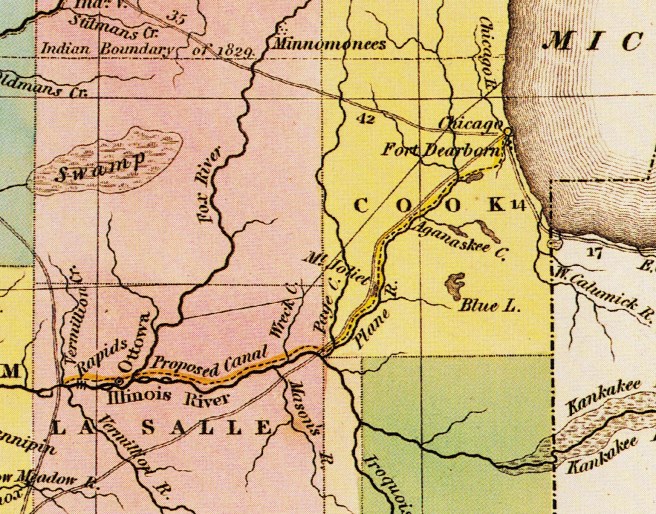
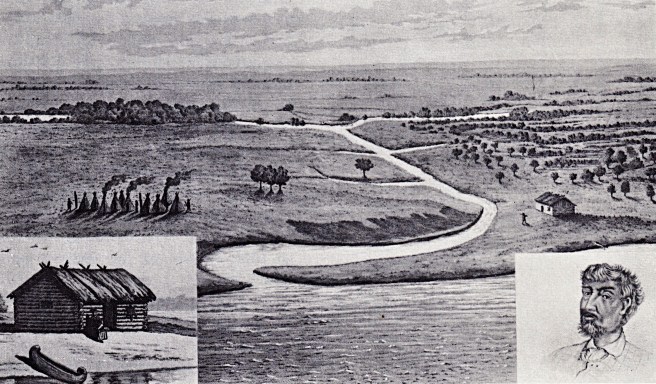
1.13. THE FEDERAL LANDGRANT FOR THE CANAL

Meanwhile, the newly created state of Illinois wasted little time in initiating plans for the Chicago canal’s construction.  The governor of the new state, Shadrack Bond, ordered the first survey of the strip of land previously ceded by the Natives in 1816, and in June 1821 Surveyor John Walls surveyed Township 39 North of the baseline, Range 14 East of the Third Principal Meridian imposing the geometric rigor of the 1785 Land Ordinance onto the virgin prairie along the Chicago River. Gov. Bond also proposed that some of the proceeds from the sale of lands set aside by the Federal Enabling Act for the construction of roads be diverted to help pay for the canal.   Consequently, Illinois Senator Jesse B. Thomas and Congressman Daniel P. Cook set out to secure the support of the Federal government for this endeavor.  Their initial labors achieved a modicum of success when Congress voted on March 30, 1822, to give the state permission to dig the canal on Federal property. 
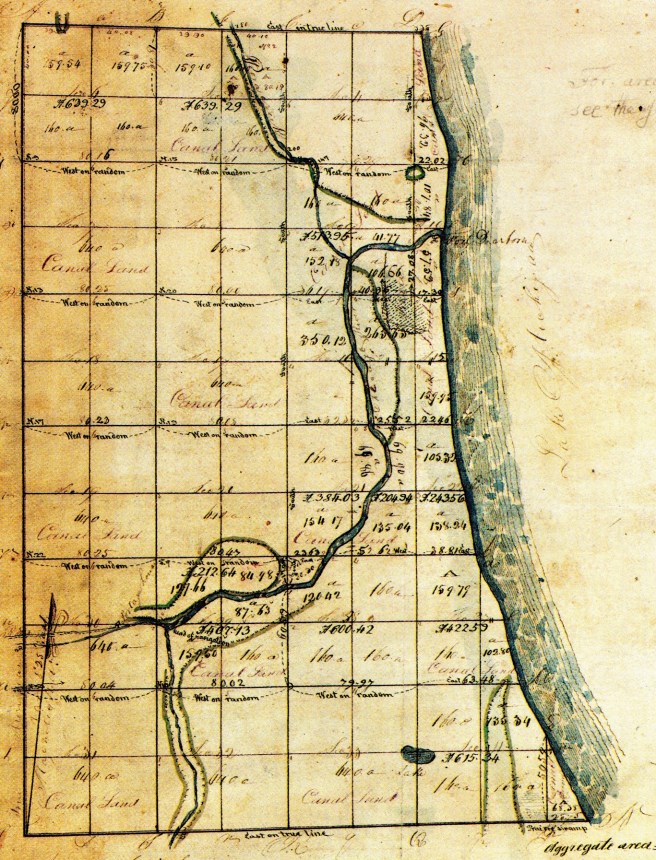
John Walls’ Survey of Township 39 North, Range 14 East, June 1821. The rational order of the human mind is imposed upon the topography surrounding the Chicago River. (Holland, Chicago in Maps)

More importantly, however meager it may have appeared, Congress not only voted $10,000 to pay for the surveys already begun, but also donated a strip of land comprising ninety feet on each side of the proposed route as well as all material (timber, etc.) on the adjacent public land.  Congress had set the precedent for granting former lands of the Native tribes to the states to fund internal improvements some twenty years earlier in 1802, when it gave “public lands” in Ohio to finance the construction of roads. Thus encouraged, the Illinois House established on February 14, 1823, a canal commission to complete the surveys and prepare an estimate of the cost to construct the canal.  Undoubtedly encouraged by the imminent completion of the Erie Canal scheduled for October 1825, the Illinois & Michigan Canal Company was optimistically incorporated on January 17, 1825, with stock initially valued at $1 million.  Sufficient private capital, however, was not willingly committed to such a long-term venture, so the legislature annulled the company a year later.  Pressure then began to build on the State, however, to start construction on its canal, so the state, following the highly-contentious Presidential election of 1824 that saw the election of Massachusetts’ John Quincy Adams, over Andrew Jackson by a single vote in a run-off election in the House of Representatives, who was more predisposed to internal improvements than had been the Virginians Jefferson, Madison, and Monroe, Illinois sent Cook back to Washington, hoping to increase the Federal government’s investment in the canal.

Once back in Washington in 1826, Cook was able to use the completion of the Erie Canal in the previous October to aid his argument.  The Erie Canal’s Grand Celebration on October 26, had begun with a successive cannonade by canons placed within earshot of each other starting at Buffalo along the entire length the Canal and down the Hudson River to New York City and back.  The “Grand Salute” took three hours and twenty minutes.  Meanwhile a flotilla of canal boats, led by Gov. Clinton aboard the Seneca Chief, departed on a ten-day trip to New York City, where Clinton ceremonious poured a keg of Lake Erie water into New York Harbor, consummating the “Wedding of the Waters.”

Cook pursued Federal funding for the Chicago canal claiming that it was an issue of national, and not merely regional importance due to its potential ability to facilitate troop and supply movements during wartime, citing the now completed Erie Canal.  Illinois’ political hunch to approach the new Congress and President paid off as the constitutional logjam over the role of the Federal government in Internal Improvements was broken by Adams with his goal of a national system of transportation and communications. (If Jackson had won the election, it is quite conceivable, based on his later record on internal improvements, that the canal would have remained still-born for the better part of what would have been Jackson’s eight year term.  Therefore, Adams’ election was critical to the founding of Chicago, for without the 1827 landgrant, there would have been no funding for the canal, let alone the surveys needed to sell the real estate at the mouth of the river.)  
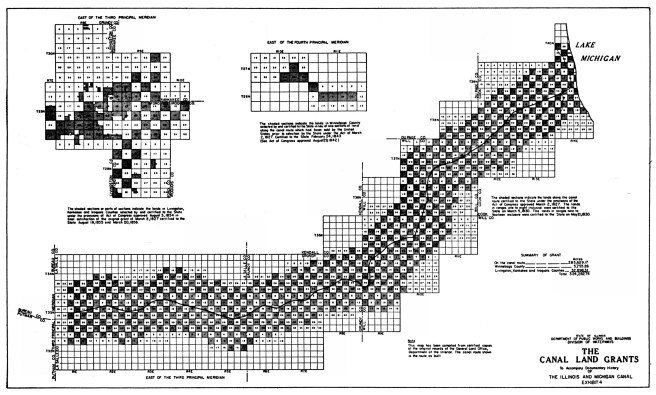
Survey and Land Grant Map, Illinois and Michigan Canal, 1829. Note the alternate sections given to the state by the Federal government, the sale of which was intended to finance the construction of the canal. (Roche, Plans of Chicago)

On March 2, 1827, Congress approved a landgrant to Illinois consisting of the original landgrant, as well as the alternate five sections (commonly referred to as the “checkerboard system”) within a ten-section width that followed the canal’s route.  The sale of this land that totaled in excess of 284,000 acres (the equivalent of a width of five square miles along the path of the canal), was intended to help finance the construction of the Chicago canal.  The plan was quite straightforward.  The state would first sell the land in its sections to private citizens, in order to generate funds to pay for the canal’s construction, while the Federal government held onto its alternating sections for sale at a later date.  Theoretically, the construction of the canal and the corresponding improvements made in the state’s sections would increase the value of the Federal holdings, so that when these were sold, the Federal government would recoup the cost of the initial giveaway to the state.

1.14. THE DEMOCRATS TAKE CONTROL: ANDREW JACKSON AND MARTIN VAN BUREN

While one could credit Pres. Adams’ support for internal improvements as having encouraged these early efforts to build a network of roads and canals throughout the country, his involvement was to be short-lived as Jackson, who approached the 1828 election as a duel to regain his lost honor after the 1824 election, easily defeated Adams’ reelection bid. The 1828 election marked the end of the unity of the “Era of Good Feelings” as the Democratic-Republican Party of Thomas Jefferson split between those who backed Adams, who eventually were referred to as “National Republicans,” and those who supported Jackson, who eventually dropped the word Republican from their party, preferring to known as “Democrats.”

As Jackson mounted his campaign to challenge Adams’ reelection in 1828, he was courted by then Gov. DeWitt Clinton and Sen. Martin Van Buren, the leaders of the two factions of the most influential state political party in the North, New York’s Democratic-Republican Party. Martin Van Buren (note: he will be responsible for the most impact on Chicago’s early growth) had been born in Kinderhook, NY, just south of Albany, and after having finished his law studies, had gravitated to New York State politics in Albany, a field for which his innate talents of genial conversation and perpetual scheming would serve him well.  Following DeWitt Clinton’s election in 1813 as the Mayor of New York, coming after his unsuccessful bid to oust Pres. Madison, Van Buren had joined the “Opposition Party,” the Albany faction of New York State’s Democratic-Republican Party who opposed Clinton’s faction (whose power base was in “downstate” New York City).  Following Clinton’s election as Governor on July 1, 1817, Van Buren had formed the “Bucktail” faction of the party, in conjunction with and modeled after New York City’s Tammany Hall, the original target of Mayor Clinton’s political reforms, (Van Buren had even chosen Tammany’s symbol, a deer’s tail worn in one’s hat, as the new group’s symbol.) to oppose Gov. Clinton’s control of the party and its patronage throughout the state.  Van Buren used the new organization to leapfrog over Clinton onto the national political stage with his election to the U. S. Senate in late 1820.  In order to oust Clinton as Governor, Van Buren then formed and became the leader of the “Albany Regency,” one of America’s early political machines that ran the state’s Democratic-Republican politics through tight organization and by controlling the patronage that flowed from the New York State Capitol.  Meanwhile in the U.S. Senate, Van Buren had matured in national politics, where he became acquainted with Gen. Jackson following his election as Tennessee’s Senator in 1822.

Following Jackson’s unsuccessful 1824 Presidential campaign, Van Buren had joined forces with Adams’ Vice-President John C. Calhoun, who eventually also became opposed to Adams, and privately had advanced Calhoun’s interest in being named as Jackson’s Vice-President in the coming 1828 election as a means of blunting his nemesis Clinton’s chances of becoming Vice-President.  Clinton, having already run a Presidential campaign, appears to have had the inside track within the Jackson campaign, but unfortunately, suddenly died at the relatively young age of fifty-eight on Feb. 11, 1828, leaving Van Buren, the “Little Magician” who saw partisan politics as a game to win, to be the architect for Jackson’s campaign, and thus, expanded the Albany Regency’s “machine politics” onto the national stage.  Following Jackson’s election in 1828 as President and Calhoun’s re-election as Vice-President, Jackson named Van Buren as his Secretary of State.  As we will see, if Clinton had lived, his influence on Jackson might have swayed the President’s mind to a more “nationalistic” view of the need for Federal internal improvements, similar to Clinton’s Erie Canal, that could have resulted in a better organized national system of transportation that could have cemented St. Louis’ role as the center of the West.  With Van Buren advising Jackson, internal improvements would be approved in a rather ad hoc manner along the lines of political expediency with little, if any centralized planning that over time would work to the long-term benefit of Chicago.  The ripples of Van Buren’s growing influence and power would soon impact the mouth of the Chicago River…

Further reading:

Andreas, Alfred T. History of Chicago, 3 vols. Chicago, 1884-1886. Reprint, New York: Arno Press, 1975.

Harpster, Jack. A Biography of William B. Ogden. Carbondale: Southern Illinois University, 2009.

(If you have any questions or suggestions, please feel free to eMail me at: thearchitectureprofessor@gmail.com)

1.12. ST. LOUIS: THE MISSOURI COMPROMISE AND THOMAS HART BENTON

The construction of the Illinois-Michigan Canal at the Chicago River was supported by the majority of St. Louis’ civic leaders, for it would link Lake Michigan to the Illinois River, that emptied into the Mississippi only fifteen miles upriver from the mouth of the Missouri River and would give St. Louis a direct water route to the Great Lakes, and with the anticipated completion the Erie Canal, a second route to the Atlantic Ocean.  The Chicago canal, in conjunction with the anticipated completed National Highway to Washington, therefore, would cement St. Louis’ centrality in the West as nature had seemingly blessed its location not only at the confluence of the Mississippi, the Missouri, and the Illinois Rivers, but also only some 150 miles upriver from where the Ohio River joined the Mississippi, which placed the city at the nexus of four of the country’s then larger river basins.  After Cincinnati, St. Louis was the largest city in the West (of course, New Orleans in the South was still the largest west of the Appalachians), and indeed, it was where explorers and fur traders who wanted to travel west of the Mississippi River either up the Missouri River to Oregon or along the Santa Fe Trail to the southwest usually started their journey.

The National Road, from Cumberland, MD (1811) to Vandalia, IL (1837). (Online)

The future of St. Louis as the commercial hub of the trans-Mississippi basin was quite self-evident to the geologist and self-appointed researcher of Native Americans, Henry Schoolcraft, who travelled through St. Louis in early 1819, and recorded that the city would be “the future seat of empire for the vast basin of land, situated between the Alleghany [sic] and the Rocky Mountains on the east and west, and between the northern Lakes and the Gulph [sic] of Mexico on the north and south… no place in the world, situated so far from the ocean, can at all compare with its for commercial advantages.”  Thomas Hart Benton, a relative newcomer to the city, wholeheartedly agreed with Schoolcraft’s observation.  Benton, originally from North Carolina where he had been dismissed from the University of North Carolina for stealing money from fellow students, had moved to escape the scandal to Tennessee, where he soon became the protégé of Gen. Andrew Jackson, being named his aide-de-camp at the start of the War of 1812.  A personal disagreement with his mentor in 1813, however, resulted in a gunfight in which Benton’s brother had shot Jackson in the arm that ended the relationship.  With the end of the war, once again to avoid the consequences of his actions, Benton had moved even farther west to reinvent himself, this time to the thriving city of St. Louis in the fall of 1815, where he managed to set himself up as the Editor of the local Democratic newspaper, the St. Louis Enquirer, that gave him a platform for his Jacksonian ideals  and for Missouri statehood.

In June 1819, following Schoolcraft’s visit, Benton published an editorial in which he summarized his plans for his adopted hometown, in which he had envisioned St. Louis as the hub of a western system of radiating waterways and national roads.  To augment the region’s natural waterways, he had proposed that the Federal government extend the National Road to carry mail from Washington, D.C., to St. Louis (the National Road had been completed to Wheeling only the year before, and, indeed, Congress approved the extension on May 15 of the following year).  His plan also included a second post road (which Congress did have the authority to fund) from St. Louis to Louisville, by way of Vincennes, IN, (located on the Wabash River and the oldest and largest town in Indiana at the time) and a third post road from St. Louis to New Orleans.  He also stated that St. Louis should be made a Federal port of entry with its own customs house, in anticipation of the construction of the Chicago canal, and also wanted the government to build a canal to link the Mississippi River with Lake Superior.  Thereby, St. Louis would become the transportation center of the country through which all traffic from the East and South would naturally flow on its way to the West and on to the Pacific.  And he meant not just to the Pacific, but all the way to China.  He meant to break the monopoly of the China ocean trade then held by New England’s shipping merchants with this overland route so that St. Louis’ “small capitalists” might share in the bounty of the Oriental trade.

There was still one hurdle confronting these plans of St. Louis’ new champion, however, Missouri was not yet a state.  Louisiana had been the first state located in the Louisiana Purchase to achieve statehood in 1812.  Prior to the Purchase, both Spain and France had permitted slavery in the region, so Louisiana entered as a slave state.  The area around St. Louis was conducive to the growing of hemp, so Southern planters had settled in the area with their slaves, imparting a slave culture to Missouri, predisposing it to being admitted as a slave state.  Debate in the House on the issue began innocently enough on Feb. 13, 1819, until Rep. James Tallmadge, Jr, of New York, who had been Gov. George Clinton’s secretary and was aligned with DeWitt Clinton’s Democratic-Republican faction, stood up and “tossed a bombshell into the Era of Good Feelings” by proposing an amendment that, for all practical purposes, would have prohibited the extension of slavery into the proposed state, that also reignited the bitter split of the young nation into its two completing Sectional ideologies. Speaker Clay, working with Sen. Daniel Webster of Massachusetts and Sen, John C. Calhoun of South Carolina, eventually was able to hammer out what is known as the Missouri Compromise of May 8, 1820, where Missouri was admitted as a slave state, that was offset with the admission of Maine as a free state, with the caveat added by Illinois’ first term Sen. Jesse B. Thomas, that all remaining territory in the Territory north of Missouri’s southern border at the 36° 30’ parallel would remain free of slavery, while nothing was stated about the territory south of the parallel, (truthfully, only a small portion of the Louisiana Territory was located south of the line).

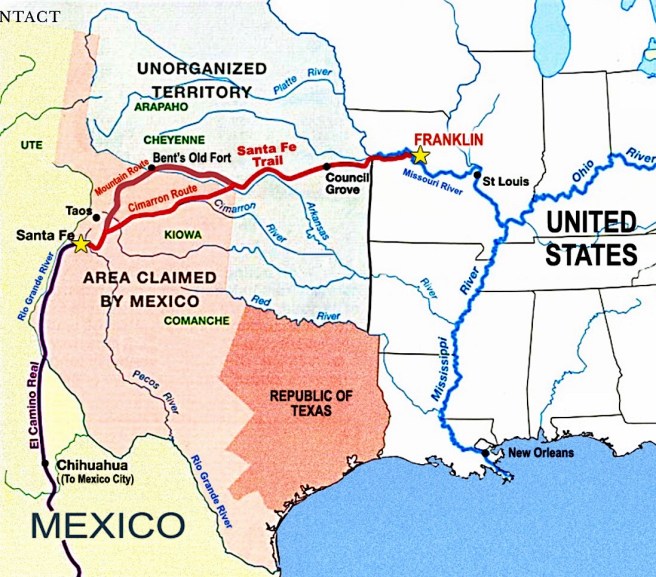
Map of the Santa Fe Trail: From St. Louis to Santa Fe to Mexico City. (Online)

The following year, St. Louis’s prospects improved all the more when Mexico won its independence from Spain in 1821.  Much of St. Louis’ initial wealth had been the result of the fur/silver trade with Santa Fe.  Although the area’s traders had initiated a thriving trade with Santa Fe back in 1739, for which they had eventually been granted a monopoly by the Spanish colonial government, that brought to the city hard currency or specie, i.e., silver, of which the west was always in need, the 1803 Louisiana Purchase changed the political landscape with the Spanish colonial authorities shutting down all trade with the Americans. However, in September 1821, William Becknell, a businessman from Franklin, MO, (located in the middle of the state) who had spent much of his capital in an unsuccessful bid for political office and needing a solution to his financial predicament, had taken a trading party loaded with goods that included calico and cotton cloth, on pack mules hoping to reach Santa Fe where he might dispose of these at a handsome profit. The timing of Becknell’s trip could not have been better for unbeknowst to him, Mexico had declared its independence from Spain on September 24, 1821.  Becknell arrived in Santa Fe in mid-November to the open arms of its citizens, who offered their silver coins for his goods.  He returned the following year along a slightly different route that he had to modify to accommodate the wagons he now used, thus establishing the route of the Santa Fe Trail, along which wealthy Santa Fe merchants imported American-made goods in exchange for furs and silver, the hard currency or specie so much in demand throughout the U.S.  (The silver thus gained by the U.S. had amounted to over $8.3 million by 1836.) 

Becknell’s good fortune in 1821 was mirrored by Benton who, following Clay’s Missouri Compromise of 1820 in which Missouri was made a state, was elected to be one of the new state’s U.S. Senators, where he would champion the growth of the West, and defend the interests of his adopted hometown for the next thirty years, the first U.S. Senator to serve five consecutive terms.  His first piece of legislation called for the Federal government to construct a road along the Santa Fe Trail.  On March 3, 1825, Congress approved a westward extension of the planned National Road from St. Louis to Jefferson City, the newly named state capital located midway along the Missouri River between St. Louis and Independence (therefore, being located astride both what would eventually be known as the Santa Fe and the Oregon Trails) that was one of the last bills signed into law by Pres. James Monroe.  (The Road’s construction would fitfully continue until the Panic of 1837 halted the Federal funding of its construction at Vandalia, IL, then the state capital, some 60 miles short of St. Louis.)  Monroe had been much more sympathetic to using Federal funds for internal improvements than had been his predecessors, probably having developed a better appreciation for the need to link the new states west of the Appalachians to the Atlantic Coast.  On April 30, 1824, with the successful completion of the Erie Canal in the North on the horizon, he had also signed a bill that provided funding for the necessary surveys to construct the Chesapeake & Ohio Canal in the country’s mid-section that was planned in the short term to link Baltimore to the start of the National Road at Cumberland, and in the long term, to the Ohio River at Pittsburgh.

(If you have any questions or suggestions, please feel free to eMail me at: thearchitectureprofessor@gmail.com)
1.10. DEWITT CLINTON AND THE ERIE CANAL

The Democratic-Republican Mayor of New York City DeWitt Clinton had played a leading role in the Erie Canal Commission from its inception in 1810 to the actual start of its construction.  Clinton was the nephew of George Clinton, longtime Democratic-Republican Governor of New York who had succeeded Aaron Burr as Jefferson’s Vice President in 1800, following Jefferson’s dropping Burr from his reelection ticket due to his disgust over Burr’s refusal to defer to Jefferson in the 1800 election that had ended in a tie in the Electoral College, and was resolved in Jefferson’s favor only after 36 votes in the House of Representatives.  In 1800, in order to assist his own election as President, Burr had reorganized Tammany Hall, a Democratic-Republican Party political machine in New York City.  Two years later, DeWitt Clinton had instigated a split within the state’s Democratic-Republican Party by publicly accusing Burr of being a traitor to the party. The following year the younger Clinton had been nominated to be New York City’s Mayor in 1803, a position from which he would not only fight to cleanse the city’s patronage positions of Tammany’s people by replacing them with his own supporters, but also promote the idea of building the canal. (Burr’s dual with Hamilton occurred in 1804.)

Meanwhile, Clinton’s uncle, then Jefferson’s Vice-President, had attempted to run as the party’s Presidential nominee in 1808, but had been outmaneuvered by James Madison and was reelected as Madison’s Vice-President in 1808.  George Clinton had not foregone his presidential aspirations, however, and was positioning for a direct challenge to his party’s incumbent President in 1812 when he died from a heart attack in April 1812, only weeks before Madison would sign Congress’ Declaration of War.   The supporters of the elder Clinton then shifted their support to DeWitt Clinton, who, in the meantime, had won a special election as New York’s Lieutenant Governor in 1811.  DeWitt Clinton lost a hard-fought presidential campaign to Madison in 1812 by a tally in the Electoral College of 128 to 89.  Clinton returned to the Mayor’s office until he succeeded in being elected the Governor of New York, a position he assumed on July 1, 1817, only three days before construction on the canal began.  

Route of the Erie Canal, 1825. (Online)

It would take eight years (and no Federal funding) to complete the 363 mile-long, all-water route between the Atlantic and Lake Erie through American-controlled land that started at the mouth of the Mohawk River at the Hudson River, just north of Albany, straight west to Buffalo at the eastern tip of Lake Erie just upriver from Niagara Falls.  From Albany water traffic could continue down the Hudson to New York City and then to the Atlantic; hence, New York City, as well as Albany, could reap the benefits of being connected to the expanding western hinterland by a continuous all-water route, that would also eventually prove beneficial to such future Great Lake ports as Buffalo, Cleveland, Toledo, Detroit, and, eventually, Chicago.  Ultimately, this system would alter the pattern of western migration and allow New York City (and, more importantly, the North) to compete with the Mississippi River system and New Orleans (and the South) as the major ocean port-of-entry for the growing trade and political allegiance of the new inland states of the NorthWest.

1.11. MOVING CHICAGO FROM WISCONSIN TO ILLINOIS

With the potential of an all-water direct route from New York City into the Great Lakes system to become a reality, the Chicago River canal’s importance in antebellum geopolitics truly began to be appreciated by leaders from both the North and the South.  When the Illinois territorial legislature first petitioned Congress in January 1818 for statehood and admission into the Union, the proposed northern border, although originally set to be tangent to the southern tip of Lake Michigan in the fifth article of the 1787 Northwest Ordinance, was located some ten miles further north, parallel to Indiana’s northern border that had been so moved when it was granted statehood in 1816 so that the state would have a shoreline with the lake.  This posed a potential stumbling block for those who were backing the canal project, however, for it meant that the proposed route of the canal would still be under the jurisdiction of two states.  While the bulk of the canal would be located in Illinois, the mouth of the Chicago River into Lake Michigan would still be under the jurisdiction of Wisconsin.  During the bill’s debate, however, Illinois’ representative Nathaniel Pope, proposed an amendment that pushed the northern boundary of the new state almost fifty miles farther north.  Using the rationale that the proposed canal, when built, should be solely under the jurisdiction of one state, he argued that the mouth of the Chicago River should be included within Illinois’ borders. Shrewdly, the move of the state’s northern border much farther north than the mouth of the Chicago River also would gather into the new state much of the lead ore (and its revenues) that had been recently found to be centered around the town of Galena that otherwise would have remained solely within the control of Wisconsin.

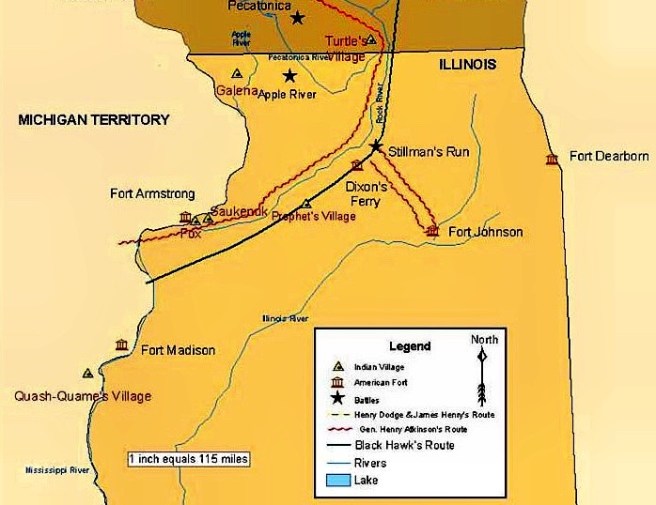
Map Showing Location of Fort Armstrong, Saukenuk, and Galena. Note the original Illinois border was to be south of Fort Dearborn. (Online)

The real concern of Pope, an anti-slavery proponent, however, ran much deeper than the eventual commercial success of the canal or the state’s potential revenues.  Indicative of America’s delicate balancing act at the time of maintaining the same number of slave states as free states in the Union, Mississippi was being paired in 1817 with Illinois for statehood.  Pope worried that the proposed state of Illinois as originally laid out, that up to this time had developed a Southern, pro-slavery orientation with the initial river settlements in the southern half of the state that were dependent upon St. Louis, would actually tip the balance in favor of the South.  Therefore, the extension of the state’s northern boundary to include the Chicago River would give Illinois an offsetting connection with the Northern Great Lakes, and a fighting chance to remain free of slavery.  Hence, the Union’s status quo might be preserved.  Congress was swayed by Pope’s one-state canal argument and ratified the petition on April 13, 1818, with Illinois formally becoming a state (in which was located the mouth of the Chicago River as well as the lead mines of Galena) with its more northern border at 42° 30’ on December 3, 1818.

John Melish (?), Map of Illinois, 1818. Note that the process of surveying the state has not yet made its way to the remote northeastern corner of the state. (Virga, Illinois: Mapping the Prairie State)

FURTHER READING:

Andreas, Alfred T. History of Chicago, 3 vols. Chicago, 1884-1886. Reprint, New York: Arno Press, 1975.

(If you have any questions or suggestions, please feel free to eMail me at: thearchitectureprofessor@gmail.com)

1.9. FEDERAL PLANNING FOR ROADS AND CANALS

Following the end of the War, Pres. Madison had cleverly decided to build upon the war-imposed sense of national unity and in his seventh Annual Message to Congress, dated December 5, 1815, he included an ambitious plan for “establishing throughout our country the roads and canals which can best be executed under the national authority.”  It was the last five words of this sentence that revealed the subtle bone of contention of just what was the constitutional authority of the Federal government as it pertained to funding internal improvements?  Following Jefferson’s precedent, Madison supported the Federal government’s involvement in funding internal improvements, if such authority could first be legally obtained by an amendment to the Constitution.  In his push for internal improvements, Madison would be ably served by two Congressmen, John C. Calhoun from South Carolina and Henry Clay from Kentucky, who became the Speaker of the House on March 4, 1815, and who shared the President’s “nationalist” vision for the future on the young country.  

In April 1816, Congress appropriated $100,000 for the resumed construction of the National Road that allowed it to be completed to Wheeling on August 1, 1818.  Following the national election of 1816, the lame duck Congress during the winter of 1816-17, passed the Bonus Bill that called for the $1.5 million bonus that the Second Bank of the United States was to pay the Federal government for its initial charter, in addition to the annual dividends that the BUS was to pay the government, to be used to fund a national network of roads and canals.  Calhoun, initially a staunch supporter of the Union, had proposed the bill: “We are under the most imperious obligations to counteract every tendency to disunion.  Let us, then, bind the republic together with a perfect system of roads and canals.  Let us conquer space.”  Even though some from the East resisted the bill as its representatives saw little to be gained by encouraging the migration of their citizens to the West, and a few Southern slaveowners feared that “if Congress can make canals, they can with more propriety emancipate,” however, Calhoun and Clay, themselves slaveowners, saw the bill through to passage, only to have the President shock the bill’s supporters by vetoing it on March 3, 1817, the last day of his tenure, on the basis that the bill simply appropriated a large fund but did not specifically specify which projects it was to be used to fund, stating there was no constitutional authority for the Federal government to fund internal improvements.  Madison had done so with the hope that an amendment would eventually be passed that would make such expenditures constitutionally legal in the future.  As Pulitzer Prize winning historian Daniel Walker Howe stated, “Faced with a choice between theoretical consistency and practical politics, Madison chose theory… Madison [thereby] not only slowed the economic development of the country but, uncharacteristically, missed an opportunity to cement the Union together.”

The National Road, from Cumberland, MD (1811) to Vandalia, IL (1837). (Online)

Had Madison signed the bill into law, the National Road would, more than likely have been completed not only earlier, but also at least through to St. Louis, providing a route for commerce (and ideas) to flow back and forth along the geographic spine of the country between the three sections of the country, with St. Louis as its logical western terminal. (The Road’s construction would fitfully continue until the Panic of 1837 halted the Federal funding of its construction at Vandalia, IL, then the state capital, some 60 miles short of St. Louis.) Madison’s veto from a narrow, philosophic position not only had defeated Calhoun’s and Clay’s best efforts to more thoroughly unite the country along its middle, but also had set a legal precedent for those who wanted to further obstruct progress for any number of reasons.  It would weigh heavily on the future of antebellum America, particularly that of the West, to the long-term detriment of St. Louis as no central highway from the Atlantic would crown it the capital of the West.  Instead, Madison’s veto of 1817, some sixteen years before the chartering of the town of Chicago, would leave the door to the West sufficient ajar for the upstart city to eventually claim that crown.

Madison was succeeded by fellow Virginian James Monroe whose term was dubbed the “era of good feelings” as, for all practical purposes, Jefferson’s Democratic-Republican party had little, if any opposition as it had all but eliminated support for Hamilton’s Federalist party.  Following the end of the War of 1812 that was perceived as a second American victory over Great Britain, Monroe had seized upon the nation’s sense of pride and began to propose a series of internal improvements that prior to the war would not have even been conceived by the party of Jefferson as it would have given too much power to the Federal government, thereby co-opting the Federalist’s agenda. In essence, Monroe’s proposals were verging on a “nationalist” agenda, not dissimilar to Hamilton’s original plans for the Federal government.  Calhoun, whom Monroe had chosen as his Secretary of War and Speaker Clay would continue to support this nationalist agenda.

The Federal government wasted little time in sending Major Stephen H. Long on a survey expedition along the Chicago canal’s proposed route, reaching the mouth of the Chicago River in September, “where it discharged itself into the lake over a bar of sand and gravel, in a rippling stream, two to fifteen yards wide, and only a few inches deep.”  The government had forced the Ottawa (that included the Potawatomis responsible for the Fort Dearborn massacre) and Chippewa tribes, who had sided with the British during the war, to sign the Treaty of St. Louis on August 24, 1816, in which they ceded a twenty-mile-wide strip of land from the mouth of the Chicago River southwest along the portage to Ottawa, within which was contained the proposed route of the canal.  In his report, Long decried the danger to lake vessels due to the lack of any natural harbors along the southwestern portion of Lake Michigan and proposed the construction of two piers at the sandbar to facilitate the removal of the sand and to create a point of refuge for shipping by allowing deep draught vessels to enter the river.  Those with foresight within the Federal government were, therefore, planning for the eventual construction of a canal from Lake Michigan to the Illinois River, even before construction of the Erie Canal had finally started in New York on July 4, 1817.

FURTHER READING:

Howe, Daniel Walker.  What Hath God Wrought: The Transformation of America, 1815-1848. New York: Oxford University Press, 2007.

(If you have any questions or suggestions, please feel free to eMail me at: thearchitectureprofessor@gmail.com)
1.7. THE POST-WAR PERIOD: ASTOR GAINS A MONOPOLY IN THE REGION’S FUR TRADE

While the Treaty of Ghent ended the fighting between the U.S. and Great Britain, its terms, for all practical purposes, simply returned the situation of the two combatants to where it was before the start of hostilities.  The same, however, could not be said of the situation for the Native Americans.  The war had given Gen. Andrew Jackson the excuse he needed to begin the removal from the territory southwest of the Ohio River of the majority of its Native population, opening the region to Euro-American settlers.  Meanwhile, in the NorthWest Territory, Natives who had fought alongside the British could no longer rely upon their protection.  Madison’s Secretary of War William H. Crawford ordered that the army build a ring of forts from St. Louis around the Great Lakes to Detroit to discourage the British from continuing in the region’s fur trade, as well as to prevent their further contact with the local tribes.  Those Natives who had managed to survive by playing one side against the other before the war, could no longer use the British as an effective counter to the growing number of American settlers.

Map Showing Location of Fort Armstrong (Rock Island), Saukenuk, and Galena. Note the original Illinois border was to be south of Fort Dearborn. (Online)

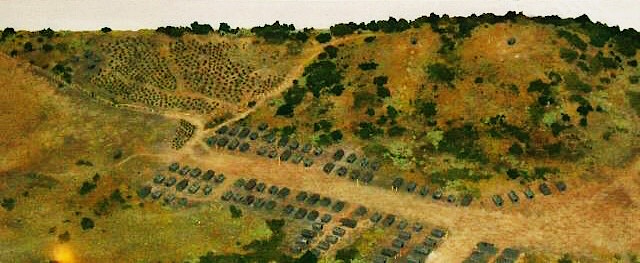
On May 10, 1816, American troops sailing up the Mississippi River arrived at Rock Island, the largest island along the Mississippi that was strategically important because it was located just upriver from the mouth of the Rock River, the major river system in northern Illinois and south central Wisconsin and commenced building Fort Armstrong on the island.  Strategically, it was also located near the largest Native Sauk tribe village, Saukenuk, only four miles to south along the north bank of the Rock River.  At this time, the village, with an estimated 4800 people, was the largest human settlement in Illinois.

Diorama of Saukenuk, John Hauberg Museum of Native American Life. (Online)

Some two months after the troops had arrived at Rock Island to build Fort Armstrong, American troops finally returned to the Chicago River to rebuild Fort Dearborn in July 1816, discovering the sun-bleached remains of the massacre’s victims.   These forts were two in a line of seven new forts built by the U.S. to discourage not only any further British military incursions, but also any entry into the area by British and Canadian fur companies that had been banned from the fur trade in U.S. territory by Congress after the war. Astor had initially proposed this at the start of the war, and consequently had gained a monopoly over the region’s fur trade when his British partners in the South West Company were, therefore, forced to sell their interests to him. In the spring of 1817, Astor changed the company’s name back to its original, the American Fur Company.  He then sent Ramsey Crooks to Mackinac as the company’s agent to restore the region’s fur trade that had languished during the war.  Crooks, desiring to reestablish the American Fur Company’s intimate, but informal arrangements for the Fort Dearborn outpost’s fur trade, contacted John Kinzie at the Chicago River who had just returned to his home after having narrowly escaped the Fort Dearborn massacre.  This relationship was further reinforced in the summer of 1818, when Kinzie took his oldest son, John H. Kinzie, to Mackinac to be indentured with the company for five years under Crook’s supervision.

Lt. William S. Evileth, the second Fort Dearborn, 1816. The first building in Chicago reputed to have been designed by an architect. (Andreas, History of Chicago-1)

Kinzie’s return to the Chicago River was apparently in response to the new and successful competition of John Crafts, an agent for the Detroit company of Conant & Mack, who had entered the Fort Dearborn market during the void caused by the war.  Astor’s company responded in the fall of 1818 not only by moving its Milwaukee agent, Jean Baptiste Beaubien to Fort Dearborn to supplement Kinzie, but also by sending one hundred well-supplied men, known as the Illinois brigade, to combat Crafts’ success throughout Northern Illinois.  Among these traders was sixteen-year-old Gurdon Saltonstall Hubbard, who became the most successful agent of the American Fur Company in the Illinois territory, traveling between Mackinac and Fort Dearborn each year, becoming “known to every man, woman, and child at the fort.” This was especially true with John Kinzie, at whose house Hubbard stayed while visiting the growing Fort Dearborn settlement, as well as with John H. Kinzie at Mackinac.  Beaubien and Hubbard were so successful at cutting into Crafts’ market that Conant & Mack sold their operation to Astor in 1822, giving the American Fur Company a monopoly of the fur trade in Illinois.

1.8. THE GALENA LEAD RUSH

Fort Armstrong’s location had also interposed itself between Saukenuk and the rich lead deposits centered around the town of Galena that was only 90 miles north of the fort. Galena was then slated be in the southern portion of the future state of Wisconsin (the Northwest Ordinance had set the Illinois/Wisconsin border to be tangent with the southern tip of Lake Michigan)  Following the erection of the fort, one of its garrison, Col. George Davenport, retired from the army later in 1816 and had shipped the first boatload of mined lead down the Mississippi to New Orleans.   As lead was critical for military ammunition, the U.S. Department of War would eventually take control over the mines in 1822 and began to lease them to settlers, sparking the country’s first mineral rush.  Regular Mississippi steamboat transit to Galena would begin in 1824 and by 1828, Galena would boast a population of over 10,000, the new residents having traveled either up the Mississippi or down the Rock or Wisconsin Rivers from the Great Lakes.  Galena was then not only the largest city in Illinois (Illinois had been granted statehood in 1818), but it was also larger than St. Louis at this moment and became the major port in the upper Mississippi valley.  In fact, the only city in the West larger than Galena during its “boom times” was Cincinnati whose population in 1830 of 24,831 made it the largest and most important city in the West, a position it would retain until the end of the Civil War.

FURTHER READING:

Andreas, Alfred T. History of Chicago, 3 vols. Chicago, 1884-1886. Reprint, New York: Arno Press, 1975.

Pierce, Bessie Louis. A History of Chicago– 3 volumes. New York: Knopf. 1940.

(If you have any questions or suggestions, please feel free to eMail me at: thearchitectureprofessor@gmail.com)

1.6. THE WAR OF 1812: THE FORT DEARBORN MASSACRE

But events across the ocean were about to impact Jefferson’s rosy outlook as the Napoleonic Wars began to seriously impact American businesses.  Following Adm. Nelson’s victory over the French at the Battle of Trafalgar on Oct. 21, 1805, both the British and the French had started to interfere with American shipping, even though the U.S. had steadfastly remained neutral.  The British routinely stopped American ships on the pretext of searching for deserters, but with the actual goal of impressing them, and any men of questionable citizenship into the British navy.  These actions had so enraged American public opinion that Jefferson was forced to respond. Not wanting to get into a shooting war, Jefferson, naively assuming that Europe needed American exports more than American business needed European markets, made the disastrous decision to outlaw all outbound shipping of American products by signing the Embargo Act on December 22, 1807.  The results were predictable: American business interests were impacted the worst while the ban lasted for a devastating fourteen months, until Jefferson grudgingly bowed to the pressure of both the merchants and Congress by allowing Congress’ Non-intercourse Act of March 1809, that lifted the embargo on all countries except Great Britain and France, to become law on the last day of his administration.  This bill still did little to improve the economy of the Atlantic seaboard and the return to business-as-usual was short-lived, however, for Britain renewed its onerous practice of impressing American sailors.

Not all the economic consequences of Jefferson’s embargo, however, had been negative. John Jacob Astor in New York City had been importing furs from Canada since 1794 from the North-West Company, a group of Scottish and French-Canadian fur merchants that had aligned to contest the chartered rights of the “English” Hudson Bay Company, that maintained exclusive British-sanctioned export rights.  Astor, in essence, had established a dummy front for the North-West Company that also allowed the company to circumvent the British East India Company’s monopoly on the China trade, and in the process had become one of the city’s wealthier merchants by the time of the embargo.  The embargo had also stopped all trade with Canada so Astor had to act quickly to protect his business.   He approached Jefferson in 1808 and requested his permission to form a new company, the American Fur Company, with the expressed purpose of wrangling the control of the fur industry in all lands claimed by America out of the hands of both British companies and their agents.  The idea was to build a chain of trading posts from St. Louis to the Oregon country (following the route of the Lewis and Clark expedition of 1803-6), to which Jefferson gave his tacit approval.  In 1811, Astor was able to buy the British-owned Mackinac Company that he then reorganized into the new Anglo-American owned South-West Company, centered in St. Louis, that subsequently became the outlet for Kinzie’s furs from the Fort Dearborn outpost.  Astor’s efforts to gain total control of the NorthWestern fur trade at this moment came to naught, however, when Democratic-Republican Pres. James Madison and Congress declared war against Great Britain on June 18, 1812, and British military power combined with their Native allies easily swept the Americans from the region.

Within a month, the British had captured the American Fort Michilimackinac on Mackinac Island at the juncture of Lakes Michigan and Huron, leaving Fort Dearborn as one of the more western and exposed outposts of the fledging Republic.  The American commander of the West ordered the evacuation of the fort’s garrison to Fort Wayne, but as they began their retreat on August 15, a band of local Potawatomis sympathetic to the British massacred the garrison and a number of settlers, and then burned the fort to the ground.  The stark isolation at this time of the Chicago River to the bulk of the U.S. population was made apparent by the fact that the victims’ remains were left exposed to the elements for the better part of four years until American troops returned to the ruins of the fort following the end of the war after Congress ratified the Treaty of Ghent in February 17, 1815.

FURTHER READING:

Andreas, Alfred T. History of Chicago, 3 vols. Chicago, 1884-1886. Reprint, New York: Arno Press, 1975.

(If you have any questions or suggestions, please feel free to eMail me at: thearchitectureprofessor@gmail.com)
1.5. PLANNING THE ERIE CANAL

Cincinnati’s rapid growth had pushed Ohio towards statehood that was granted in 1803. In anticipation of the state’s continued expansion, Congress had agreed the previous year to earmark some of the monies gained from the sale of public lands for the construction of a road to improve travel from the Atlantic coast into the trans-Appalachian interior. By the end of 1804 the Federal government had achieved its first budget surplus.  President Jefferson in his second inaugural speech on March 4, 1805, was proud to make such an announcement and followed it up with the proposal that “the revenue thus liberated may be, by a just repartition of [the surplus] among the States… be applied in time of peace to rivers, canals, roads, arts, manufactures, education, and other great objects within each state.”  Note that Jefferson, not in favor of a strong, Federal government, had proposed that the monies be spent not directly by the Federal government, but be directed to the states for their use.  Nonetheless, a year later on March 29, 1806, he authorized the first Federal highway expenditure that was to fund improvements in the old Braddock Road that westward-bound travelers took from Cumberland, MD, at the headwaters of the Potomac River to Pittsburgh on the Ohio River.  This would extend the route of two turnpikes, one from Baltimore and the other from Washington, DC, that had been constructed over time that would link Cumberland to the Atlantic. In addition, Jefferson proposed a new Cumberland Road (what eventually would become the National Road) that was to start at Cumberland but instead of leading to Pittsburgh, jogged westward at Uniontown, PA, toward Wheeling, VA, so as to reduce the travel time on the Ohio.  From here it would run west to the state capitals of Columbus, Indianapolis, and Vandalia, thereby making travel between these cities easier. Construction did not start until 1811 and then had stalled due to lack of funding during the War of 1812.  As its course roughly paralleled the Mason-Dixon Line, adjacent communities in both the North and the South could utilize the road, therefore, antebellum Sectional jealousies played no significant role in hampering the funding of this direct land route between the Atlantic coast and the nation’s central route of water transport. 

The National Road, from Cumberland, MD (1811) to Vandalia, IL (1837). There was no “West Virginia” at this time. (Online)

These early routes to the Ohio River to the West were quite profitable for the Mid-Atlantic ports of Philadelphia (then the city with the largest economy, even though New York City’s population had surpassed it by 1790) and Baltimore as well as the newly established river ports of Cincinnati and Louisville, while the northern Atlantic ports in the Northeast, such as New York City and Boston, did not have water transportation into the trans-Appalachian hinterlands that proved to be a severe economic hindrance to the expansion of their business interests.  True, New York enjoyed easy transportation along the Hudson River as far as Albany, but this route led north, and not west.  Although the Great Lakes route represented a potential all-water passage between the Atlantic and the upper Mississippi valley (the NorthWest), it had two inherent problems.  Goods had to be transferred overland around Niagara Falls, and the St. Lawrence River, the Great Lakes’ outlet to the Atlantic, was completely under British control.  If these impediments could somehow be overcome, however, an all-water route from New York City to the Great Lakes could be forged, tapping the vast potential of the NorthWest by creating an alternative transportation route to the extant routes of the Ohio and Mississippi Rivers for the region’s products.  Fortunately, due to a geologic quirk, the only break in the Appalachian chain between the Great Lakes and the Cumberland Gap in Tennessee was the valley of the Mohawk River that flowed west to east through central New York State and joined the Hudson River just above Albany. An all-water route to Lake Erie along the Mohawk Valley had first been proposed as early as November 1784 but had been endlessly debated over the next thirty-two years in the Byzantine corridors of New York State politics.

Route of the Erie Canal, 1825. Geneva, NY, the home of Charles Butler, is at the top of Seneca Lake. (Online)

The national economy had continued on its bright trajectory so that in his annual speech to Congress in 1807 Jefferson again recommended that the surplus be directed towards internal improvements.  Not one to pass up a free dollar, the Senate on March 2, 1807, charged the Secretary of the Treasury, Albert Gallatin, to draw up a list of public improvements, especially roads and canals, towards which these funds could be directed.  Gallatin returned in April 1808 with his report, whose centerpiece was the proposal of a $20 million, nationwide system of roads and canals, among which included a canal along the Mohawk River to Lake Erie in New York and a canal that would link the Chicago River with the Illinois River.  The New York legislature responded in kind a month later by approving the funds to conduct a survey along the Mohawk Valley canal route to Lake Erie.  In an attempt to transcend New York’s political infighting, a seven-member bipartisan canal commission with representation from all of the state’s regions in play was formed in 1810 to make a highly visible, comprehensive survey of the proposed canal’s prospects.  Among its members were DeWitt Clinton, then the Democratic-Republican Mayor of New York City, Federalist Gouverneur Morris, the state’s beloved revolutionary statesman, and newly elected Democratic-Republican Congressman Peter Porter from Black Rock, located on the outskirts of Buffalo.  In his inaugural speech in Congress, Porter had proposed the use of Federal funds to build the canal at the Chicago River as a link between the Great Lakes (Buffalo just happened to be within Porter’s district, where he and his brother operated a company that controlled the portage business around Niagara Falls) and the Mississippi, in order to form a continuous waterway from Lake Erie to the Gulf of Mexico.

(If you have any questions or suggestions, please feel free to eMail me at: thearchitectureprofessor@gmail.com)

1.3. THE LOUISIANA PURCHASE AND THE BUILDING OF FORT DEARBORN

Map of the Louisiana Purchase, 1803. (Online)

Sometime in the early afternoon on August 17, 1803, Army Capt. John Whistler at the head of a garrison of troops that had been traveling from Detroit for the past thirty-five days, had finally come upon the mouth of the Chicago River, where he had been ordered to erect a fort to discourage further British military activity and to attempt to break the British control of the Native fur trade in the region.  But with the British still present on the Great Lakes as well as in control of the mouth of the St. Lawrence River, and the Spanish controlling New Orleans and the lower Mississippi following the Treaty of Paris, there was no immediate need for the Americans to forge a link between the two water systems.  The U.S. government had not shown any tangible interest in the Chicago River until 1803, when negotiations for the purchase of the Louisiana Territory and the corresponding control of the lower Mississippi, including the towns of New Orleans and St. Louis, had begun with French First Consul Napoléon Bonaparte, who had regained control over the territory from the Spanish in October 1800.  Anticipating the successful outcome of these negotiations, President Jefferson had moved to consolidate the Federal government’s control along the upper Mississippi.  On March 9, 1803, Secretary of War General Henry Dearborn had sent a letter to Col. Hamtramck, the commandant at Fort Detroit, ordering the survey of a land route from Detroit to the mouth of the Chicago River in the Indiana Territory (Chicago would be reallocated to the Territory of Illinois when Indiana was granted statehood in 1816) as well as of a site for the eventual erection of a fort. The Louisiana Purchase was formally signed in Paris on April 30, 1803, with Jefferson announcing it on July 4.  Whistler had conducted the survey in May and June, and had the garrison assigned to the fort depart from Detroit on July 14.

The Mouth of the Chicago River, 1820. (Upper: Historic Maps and Views; Below: Andreas, History of Chicago-I)

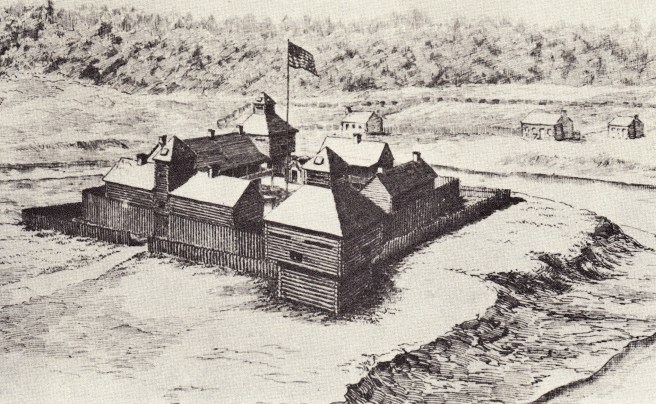
Whistler found the river, roughly 90’ wide and 20’ deep to be stagnant, due to a sandbar that had been formed by the lake’s current at the mouth of the river, that itself had correspondingly moved over time (from its present location) to almost one half of a miles to the south before it ultimately flowed into the lake (some five blocks farther to the south, at the present location of Washington Street).  Finding the area to be populated by only the buildings that du Sable had erected on the north bank, Whistler still chose to build the fort (appropriately named Fort Dearborn) on the south bank of the river at the bend in the mouth of the river that created a natural peninsula, utilizing the natural defense provided by the river to cover three of the fort’s four walls.  

The first Fort Dearborn, 1803. In plan the fort consisted of a double stockade of logs, the space between was protected by two blockhouses at opposite corners of the square. (Upper: Kogan and Wendt, Chicago: A Pictorial History; Lower: Tallmadge, Architecture in Old Chicago)

This location (as opposed to the northern bank) also provided a secure land route around the lake’s basin for supplies and reinforcements from the Federal government’s forts in Indiana, Michigan and Ohio, as well as a direct land route to the southeast, avoiding any need to cross the river in an emergency retreat.  The location of the fort would impose two long-range consequences on the development of the city of Chicago:  first, the location of the fort would keep a large tract of prime lakefront property south of the mouth of the river out of the hands of private speculators and free of commercial buildings and industry for many years; and second, early settlement would concentrate around the fort for security, as well as for the advantage of the commercial potential of the fort’s garrison, establishing the dominance of the southside of the river as the city’s commercial center during the nineteenth century.  

In the spring of 1804 John Kinzie, a Canadian fur trader originally from Quebec who had brought his family to the area in 1802, bought du Sable’s house.  Kinzie was an employee of the British-owned Mackinac Company and had quickly established himself as the leading fur and Native trader in the area, founding a series of branch outposts from Milwaukee to the Illinois River.  Employing Canadian voyaguers, these outposts all forwarded their furs to Kinzie’s house at the mouth of the river, from where they were shipped to Mackinac Island, the company’s home base.

John Kinzie’s House as it appeared in 1832. (Andreas-1, History of Chicago)

Meanwhile, the Governor of the District of Louisiana, William Henry Harrison, had taken advantage of four lonely (and reputedly drunk) Sauk Natives who had traveled to St. Louis, the District’s headquarters, to plead for the release of a tribal member accused of murder.  Harrison offered them $2,234.50 and an annuity of $1,000 for signing a treaty on November 3, 1804, that relinquished all Native claims to some fifteen million acres east of the Mississippi lying between the Illinois and Wisconsin Rivers.  The government graciously promised that all Natives could remain on the land for as long as it was owned by the Federal government, but this was quite ingenuous as the pattern had been since the founding of the Republic for the Federal government to sell all former Native lands to raise income for the fledgling nation.

1.4. JEFFERSON SENDS LEWIS AND CLARK TO THE PACIFIC

Meanwhile, during the final negotiations over the Louisiana Purchase, President Jefferson was planning an expedition led by Capt. Meriwether Lewis and Lt. William Clark to discover “the most direct and practicable water communication across this continent, for the purposes of commerce,” another attempt by Euro-Americans to discover the long sought-after Northwest Passage. As Spain controlled Alta California in the West that extended in places as far north as the 42° parallel (between the Oregon/California border), the expedition was prohibited from exploring a southern route through warmer climes.  Meanwhile, the British controlled Canada, which meant that Lewis and Clark were limited to exploring a route through a relatively narrow geographic funnel between Spanish California and British Canada, in territory crossing the unexplored northern Rocky Mountains to the Pacific Northwest, whose jurisdiction was disputed by all three governments.  (Therefore, the North had a debatable headstart, or to phase it from a different perspective, the South faced a major battle in gaining a physically contiguous route, in the coming battle over the route of the first transcontinental railroad.) 

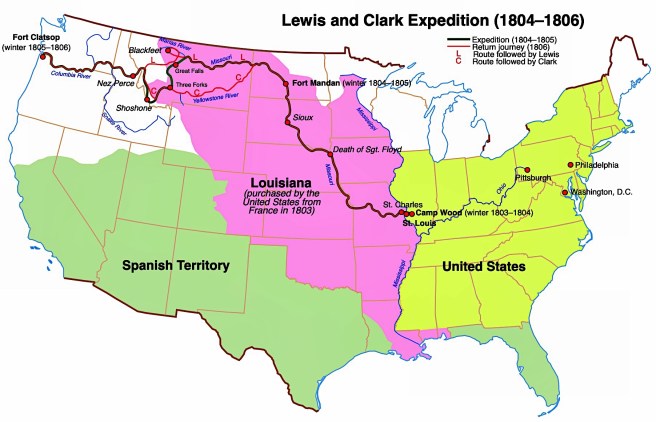
Route of Lewis and Clark Expedition, 1804-6. (Online)

The route of the expedition was to start at St. Louis, to be able to ascend the Missouri River to its headwaters and then to discover whether any of the known rivers in the Oregon country either joined it or were in its proximity, thereby posing a potential all-water route to the Pacific. Jefferson, however, was politically more concerned about having a better understanding of what type of land and natural resources were contained in the Louisiana Purchase, in addition to strengthening the U.S.’s claim on the Oregon country by hoping that Lewis and Clark would beat the British and the Spanish in making the first claim of discovery in this region.  While Lewis continued to address matters back east, Clark proceeded to erect the Corps of Discovery’s base camp, Camp Dubois, on American territory on the east bank of the Mississippi, some 15 miles upriver from St. Louis, directly across from the mouth of the Missouri River, where they were forced to wait until Spain, who had continued to administer Louisiana, formally transferred it to American authorities whose arrival had been postponed by ice on the Mississippi.  Finally, the Spanish transferred St. Louis to French officials on March 9, 1804, who, after flying the French flag for one day, then turned the city over to American officials on March 10.  The Corps then crossed the Mississippi on May 14, 1804, and would not return to St. Louis until September 23, 1806, some two years and four months later, having successfully reached the Pacific Ocean at the mouth of the Columbia River (near today’s Astoria, OR). Unfortunately, they reported that they did not find an all-water route to the Pacific Ocean.  Travel to the Pacific Coast from the United States (i.e., the Atlantic Coast), therefore, would involve either the long, three to six-month long sea voyage around Cape Horn, or the arduous and dangerous land route from St. Louis through the northern Rocky Mountains.  

FURTHER READING:

Andreas, Alfred T. History of Chicago, 3 vols. Chicago, 1884-1886. Reprint, New York: Arno Press, 1975.

Harpster, Jack. A Biography of William B. Ogden. Carbondale: Southern Illinois University, 2009.

Tallmadge, Thomas Eddy. Architecture in Old Chicago, Chicago: University of Chicago Press, 1941.

(If you have any questions or suggestions, please feel free to eMail me at: thearchitectureprofessor@gmail.com)

1.2. PLANNING THE AMERICAN SETTLEMENT OF THE NORTHWEST

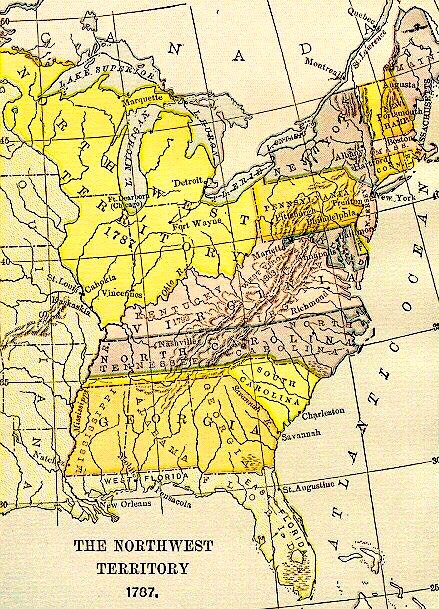
Map of the Northwest Territory, 1787. Note that the original border between Illinois and Wisconsin is mistakenly located at its final location. (Online)

Chicago’s Canadian citizenship was short-lived, however, for the area was successfully invaded early into the American Revolution during the summer of 1778 by Lt. Col. George Rogers Clark leading a force of Virginia militia and volunteers who had gathered near the Falls of the Ohio, that marked the founding of the city of Louisville, named in honor of the King of the revolution’s French allies, King Louis XVI, whose town charter was approved by Virginia two years later in 1780.  Clark’s force first captured the British forces at Kaskaskia (on the Mississippi in southern Illinois south of St. Louis) and then at Vincennes (in southern Indiana on the east bank of the Wabash River).  The war was formally ended with the signing of the Treaty of Paris on Sept. 3, 1783, with all British lands east of the Mississippi and south of the Great Lakes falling under the auspices of the U.S. Congress of the Confederation that faced the task of the disposition and governing of these “unorganized” lands and their current indigenous populations.  On April 23, 1784, Congress adopted a Land Ordinance, drafted by a committee of five delegates led by Virginian Thomas Jefferson that stated that the existing thirteen states would not expand into the territory west of the Appalachians based on their prior claims to the same, but that these states would cede these lands to Congress from which ten new states would be formed that would enjoy the same rights and responsibilities that the original thirteen states then did.  Hence, Virginia ceded its territory in Illinois to the Congress, that in the meantime had begun planning the future sale and settlement of the lands inhabited by Native American tribes that lay west of the Appalachian Mountains, north of the Ohio River, and east of the Mississippi River by passing the Land Ordinance of 1785 on May 20.  The Congress had drafted the ordinance as an orderly process to sell this newly acquired land as a method to raise funds for the Federal government that at the time did not have the legal authority to raise revenues through taxation.  The 1785 Ordinance specified a plan to systematically organize the land rationally with the use of a Cartesian or rectilinear grid.  The use of the grid to layout European cities dated back to ancient Greece during the 5th century BC.  A number of colonial cities in America had been laid out on a strict gridiron of streets, New Haven, CT (1638), Philadelphia (1682), and Savannah (1733) being probably the best examples, but the scale of this latest application of the grid to lend order to such a large land mass was unprecedented.

The Land Ordinance of 1785 and its system to survey land in the Northwest Territory. (Online)

This process for the organization of such a large land mass had originally been devised in 1764 by Thomas Hutchins, then a British captain in the Royal American Regiment, to establish an overall order to the land in northern Ohio surrendered by the French to the British following their defeat in 1763.  At the time of the passage of the 1785 Ordinance, Hutchins was the Geographer of the U.S. and was tasked with the charge “to divide the said territory into townships six miles square, by lines running due north and south, and others crossing these at right angles… The plats of the townships, respectively, shall be marked into sections of one mile square, or 640 acres”.  Therefore, unlike some American cities founded prior to 1785 such as Boston and New York (before 1811), whose street patterns reveal the influence of early human settlement and movement patterns as well as their response to local topographic features, Chicago’s future urban pattern of a rectilinear grid of streets (with the few exceptions of existing Native American paths) was influenced by Congress some forty-eight years before the town was first chartered.

On July 13, 1787, the Congress created the first Federal territory in the U.S., with the passage the Northwest Ordinance (so named in that it addressed the status of “Territory Northwest of the Ohio River”).  While the 1785 Ordinance had specified the system of how the land in this region was to be surveyed for future sale, this new Ordinance established how it would ultimately be governed.   Among its provisions, the legislation changed the number of potential states to be formed within the region from Jefferson’s original ten to be no fewer than three nor more than five.  While the Confederation Congress was addressing the disposition of the new lands in the NorthWest, it was also busy attempting to reconfigure the entire national government that had been established by the 1781 Articles of Confederation, into a more effective political system.  Two months after the Congress had approved the Northwest Ordinance, it signed the new U.S. Constitution, a fully debated compromise between the two major competing socioeconomic visions for the new country.  While these visions were not completely segregated between those in the North and those in the South, the vision shared by a majority of Southerners, best represented in the ideals of Thomas Jefferson (who eventually formed the Republican Party, now referred historically to as the Democratic-Republican party to distinguish it from today’s Republican party), envisioned “Arcadia,” a country formed of independent idyllic farms run by gentlemen within a federation of states united by Federal national government with limited powers (that did not include the funding of internal improvements such as roads), while the northern vision may best be represented by the ideals of Alexander Hamilton (who was to found the Federalist Party), who championed “Enterprise,” a country founded on unbounded trade, industry, and progress, made such by a strong, central Federal government (that could help the nation’s development by funding such internal improvements).  Almost all political issues to face the new country, from tariffs to internal improvements, would be debated through these two lenses.  The settlement and development of the trans-Appalachian lands would not escape this debate.

Significantly, the Northwest Ordinance prohibited the extension of slavery into these future states (no such prohibition applied to the territory south of the Ohio), overcoming earlier Southern Congressional resistance, and thereby, established the Ohio River as the de facto boundary between the North and South from the western tip of the Mason-Dixon Line, at the southeastern corner of Pennsylvania, to the Mississippi River.  The main north/south boundary that would divide the new territory into its future states was logically determined by simply extending a boundary from the southern tip of Lake Michigan to the east to Lake Erie and to the west to the Mississippi River.  This meant that the mouth of the Chicago River was not part of what was originally slated to be the state of Illinois but was planned to be included in the state of Wisconsin.  This seemed consistent with the initial settlement pattern of Illinois, for while the French and British fur traders had come to Illinois via the Great Lakes, with the British controlling the St. Lawrence River and maintaining a strong presence along the northern shore of the lakes, immigrants and supplies from the American East Coast at this time had primarily come via the Ohio River to the southern portion of the future state from one of three routes, as there were few openings in the Allegheny Mountains that, for all practical purposes, had walled off the Atlantic Coast from the western hinterlands.

Potomac River to its headwaters at Cumberland, and the trail to the Ohio River at Pittsburgh. The route of the Chesapeake & Ohio Canal, planned vs. built is also shown. (Online)

Settlers bound for the NorthWest who originated from as far north as downstate New York and as far south to northern Virginia could travel overland to either Pittsburgh or Wheeling (which is what the Treaty of Fort Stanwix in 1768 had attempted to stem, to little avail), where they would transfer to a vessel on the Ohio River, that flowed westward from its headwaters in the western foothills of the Allegheny Mountains, for their downriver destinations in the interior. However, they could also take the Potomac River in Virginia up to its headwaters at what is today Cumberland, MD, (not to be confused with the Cumberland Gap in Tennessee) and then set out overland along the old Braddock Road, the first trans-Appalachian route (that the British had cleared at the start of the French and Indian War in 1755 in order to capture Fort Duquesne (Pittsburgh) on the Ohio River), looking for one of the tributaries of the Monongahela River that would then take them to the Ohio River at Pittsburgh.  Settlers from southern Virginia to Georgia, meanwhile, could take the route that Daniel Boone had blazed in 1775 through the Cumberland Gap into Kentucky and on to the Ohio River.  Whichever route was chosen, the goal was to get to the Ohio River as easily as possible, that one could then float downriver to the new lands in the west.

Map of the eastern U.S., showing the Ohio River and Mississippi River routes into the NorthWest. The importance of the potential of an Erie Canal in linking New York, via the Hudson River, to the Great Lakes and that of a canal from Chicago to the Illinois River is evident. (Online)

The Ohio River, however, makes a sharp bend to the south some 100 miles upriver from Louisville that significantly increased the overland distance for those settlers destined for northern Indiana and Illinois.  Just before the Ohio turns towards the south, the Licking River in Kentucky, almost as extensive of a waterway as the Kentucky River, empties into the Ohio.  Across from the mouth of the Licking River, the Great and Little Miami Rivers with their combined watersheds reaching into the middle of Ohio, also empty into the Ohio River.  It was here, then, that the settlement of Cincinnati was founded in 1788 (within a year of the passage of the Northwest Ordinance) as a departure port for lands in the NorthWest.  With its shorter overland distance to the north as well as the combined inland watersheds of the Licking and Miami Rivers providing easy transport to inland markets, Cincinnati quickly surpassed Louisville that had no rivers into the interior, as the major port on the Ohio River.

Settlers moving into the Cincinnati region found it to be well suited for the growing of corn that could be easier transported to market if either distilled into whisky or fed to pigs.  The pigs were easier to ship back east if processed into pork and lard. Cincinnati quickly became “Porkopolis,” the country’s largest pork-processing center.  (Some of the lard in 1837 would be used by two brothers-in-law, William Proctor and James Gamble, to make industrial-processed soap, establishing one of the country’s largest and most stable companies.) Cincinnati’s location, at the midway point along the Ohio River, centered equally between and with easy river access to the newly-emerging markets in both the northern and southern states would allow it, although younger than St. Louis by some twenty-four years, to quickly surpass its western competitor in population and become the center of western business and migration from the antebellum Northern states, if for no other reason than St. Louis did not become part of the U.S. until the Louisiana Purchase was signed in 1803.

Although the British had ceded their claims to the NorthWest, no such arrangement had ever been agreed to by the Native tribes, who were reacting with increasing hostility to what they viewed as the illegal westward encroachment of the whites.  It was not until the summer of 1794 that General “Mad Anthony” Wayne was able to subdue the tribes of the Western Confederacy at the Battle of Fallen Timbers (near today’s Toledo).  Subsequently, Wayne forced an uneasy truce on the Natives with the signing of the Treaty of Greenville (Ohio) on August 3, 1795.  Among its provisions, the Natives not only surrendered all claims to the lands in southern Ohio, but also agreed to cede to the U.S. “one piece of land six miles square, at the mouth of the Chicago River, emptying into the southwest end of Lake Michigan,” and to allow free passage “from the mouth of the Chicago River to the commencement of the portage between that river and the Illinois, and down the Illinois River to the Mississippi.”  The young Federal government had its eyes on the Chicago region and the potential for a canal in this location for some thirty-five years before the town’s first Euro-American settlers had begun to displace its Native population.

FURTHER READING:

Andreas, Alfred T. History of Chicago, 3 vols. Chicago, 1884-1886. Reprint, New York: Arno Press, 1975.

Industrial Chicago-vol. 1: The Building Interests, Chicago: Goodspeed, 1891.

Lewis, Lloyd, and Smith, Henry Justin, Chicago: The History of Its Reputation, Rahway, N.J., 1929.

Pierce, Bessie Louis. A History of Chicago– 3 volumes. New York: Knopf, 1940.

(If you have any questions or suggestions, please feel free to eMail me at: thearchitectureprofessor@gmail.com)

PART ONE: CHICAGO: THE ISTHMUS IN THE NORTHWEST (1803-1848)

CHAPTER 1. DREAMS OF A CANAL INSPIRE A CITY (1803-1830)

1.1. THE COLONIAL SETTLEMENT OF THE NORTHWEST

One fall day in 1673, Jesuit missionary Jacques Marquette and French Canadian voyaguer Louis Jolliet were paddling their canoe down what would they name the Chicago River when they caught their first glimpse of the river’s mouth into the vastness of Lake Michigan.  If we look at the history of the Chicago region through an European lens and avoid the history of Native Americans, then Chicago began under the flag of the kingdom of France.  Although Jacques Cartier had planted the first French flag at the mouth of the St. Lawrence River in 1543, claiming “New France” for his King, Francis I, the colony had only managed to marginally survive as a fur-trading enterprise along the river until King Louis XIV, who began to exert his royal authority following the death of his Chief Minister, Cardinal Mazarin in 1661, declared New France as a Royal Province in 1663 in an attempt to encourage its expansion into the Pais d’en Haut (“the upper country” to the west that included the Great Lakes) with the hope of finding the much sought-after Northwest passage to the Pacific Ocean and China.  In 1668, a mission was founded at Sault Sainte Marie where Lake Superior flows into Lake Huron.  Three years later in 1671 Jesuit missionary Father Jacques Marquette founded the Mission of St. Ignace on the north shore of the Straits of Mackinac that join Lake Michigan and Lake Huron, some forty miles south of Sault Sainte Marie.  That same year Louis XIV had claimed formal possession of the entire Great Lakes region and the Mississippi Valley through the exploration of Daumont de St. Lusson, who made the formal claim at Sault Sainte Marie.  

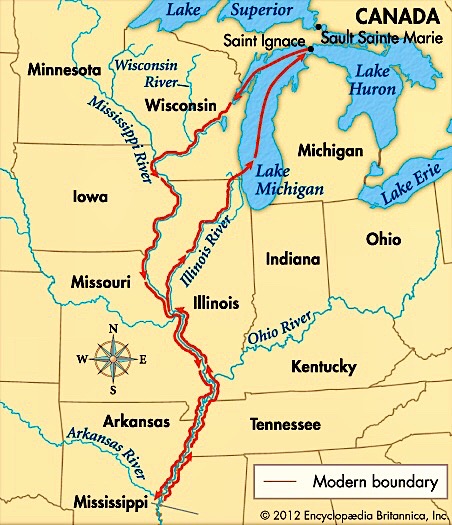
Route of Marquette and Jolliet, 1673. Note the error in this map: it shows them entering Lake Michigan at Kenosha, not at the mouth of the Chicago River. (Online)

On May 17, 1673, Marquette, accompanied by voyaguer (a seasoned transporter of furs via canoe) Jolliet, set off from St. Ignace to explore the Mississippi Valley to determine whether it was the fabled Northwest passage.  They took a route from Mackinac to the Mississippi, via the Wisconsin River, a route first traversed in 1634 by Jean Nicolet, another early voyaguer.  They reached the Mississippi on June 17, 1673, and then traveled down the river for over a month until they reached the mouth of the Arkansas River.  Here they learned from the local Native inhabitants not only that the river did not turn west to the Pacific, but also if they continued any farther south unfriendly Natives and Spanish soldiers (who had been exploring the lower Mississippi Valley for more than 130 years prior to the French expedition, starting with the Spanish explorer Hernando de Soto who in 1541 had first crossed the Mississippi River into northern Mississippi) could intercept them if they continued any farther.  Therefore, Marquette and Jolliet reversed their course and headed back to Lake Michigan, returning in the fall of 1673.  On their return they were directed by local Natives to take what is now the Illinois River back to Lake Michigan as a shorter route than from which they had started.  After traversing up the Illinois River to its head at the confluence of the Des Plaines and Kankakee Rivers, they then followed the Des Plaines for some thirty-five miles, until they were led, via a short portage to a sluggish stream, the Chicago River that emptied into Lake Michigan.

1833 Map by H.S. Tanner Showing the Route (dashed line) of the Canal. Note the portage between the Chicago River and the Des Plaines River, where Mud Lake has been drawn along the southern edge of the portage. The canal parallels but does not conjoin the Des Plaines River. It joins the Illinois River just below the “Rapids” at Starved Rock. (Ranney, Prairie Passage)

This allowed them to be the first documented Europeans to have set eyes upon the mouth of the Chicago River at Lake Michigan.  The Native population had relied on this portage between the Des Plaines River, that flowed west to the Illinois River, and ultimately to the Mississippi River, and the Chicago River, which flowed east into Lake Michigan, for easy travel between the region’s two water systems.  The portage, therefore, was an elevational plateau that divided the area’s drainage either west to the Mississippi River basin or east to the Great Lakes.  During rainy periods, the portage itself often flooded, creating a “slough” or marsh that was called “Mud Lake” that made it possible to paddle between the two rivers. 

Map of the eastern U.S., showing the Ohio River and Mississippi River routes into the NorthWest. The importance of the potential of an Erie Canal in linking New York, via the Hudson River, to the Great Lakes and that of a canal from Chicago to the Illinois River is evident. (Online)

The Chicago River, therefore, offered the potential to link the Great Lakes with the Mississippi River system with the construction of a relatively short canal between the Chicago and the Illinois Rivers.  Although other sites on the western shore of Lake Michigan, such as the mouth of the Calumet River at the southern tip of Lake Michigan or the Milwaukee River at Milwaukee, WI, were found to have better harbors on Lake Michigan, Chicago’s only natural geographic feature – the close proximity of the Chicago River to the Illinois River – was sufficient argumentative evidence for the area’s supporter’s to successfully use against those who argued in favor of the other locations, in the coming debate for the Federal government’s support to build the canal that would make Chicago the lynchpin between two of the continent’s major antebellum water transportation networks: the Great Lakes via the Erie Canal, the industrial Northeast’s water route to the West, and the Mississippi River network, the lifeline of the antebellum agricultural South and upper Midwest.  This potential had been acknowledged as early as 1673 by Jolliet who, following his return to St. Ignace, reported back to his King:

“We can quite easily go to Florida in boats, and by a very good navigation.  There would be only one canal to make by cutting only half a league of prairie, [this was not an impossible task for the French at this time, as they were midway though the construction of the 150-mile long Canal du Midi, completed in 1681] to pass from the Lake of Illinois [Michigan] into the St. Louis River [the Des Plaines and Illinois].  The route to be taken is… Lake Erie to Lake Huron [to] the Lake of Illinois.  At the extremity of this would be the cut, or canal,… to have a passage to the St. Louis River, which empties into the Mississippi… to the Gulf of Mexico…  It would facilitate the communication from Quebec and Lake Erie… and but for a water-fall which separates Lake Erie from Lake Ontario, a bark… could go to Florida by the routes of which I have spoken.”

Although the mouth of the Chicago River would serve as nothing more than a settlement for itinerant French fur trapper/traders over the next century, Chicago’s European roots did reach back to Paris.  In 1679, another early French explorer of the Chicago River, René Robert Cavalier, Sieur de la Salle, returned to the Illinois River, accompanied by the Jesuit priest Louis Hennepin.  La Salle had first sent Hennepin to explore the upper Mississippi, who eventually reached the Falls of St. Anthony (that he recorded had a drop of over 50’), where Minneapolis was later settled. La Salle then set out in 1682 to explore the lower Mississippi.  It took two months to reach the Gulf of Mexico on April 9, 1682, when he ignored the prior 140 year-old claims by the Spanish and claimed the entire river valley for his King and named it in his honor, “Louisiana,” that eventually evolved into two separate French administrative jurisdictions:  Pais de Illinois (the Illinois Country), also referred to as la Haute-Louisiane (Upper Louisiana), comprised the land that lay north of the Arkansas River and was initially governed as part of the Province of Canada, and la Basse-Louisiane (Lower Louisiana) that extended south from the Arkansas River to the Gulf of Mexico. 

Map of Pais des Ilinois, 1717. Note that “Chicagou” is located. (Bibliothèque Nationale, Cabinet des Estampes, Paris, France)

The portage at the Chicago River ultimately became a heavily traveled route that linked new settlements in Upper Louisiana back to their supply centers in Canada. Meanwhile, in 1712, Louis XIV had granted a 15-year trade monopoly in Louisiana that now included Upper Louisiana, to his banker and financial advisor Antoine Crozat, the wealthiest merchant in France, who began the serious settlement of Lower Louisiana.  This arrangement lasted only for five years, however, for following the death of Louis XIV, his successor, Phillipe II, the Duke of Orléans, Regent for Louis’ five-year old great-grandson who eventually would be crowned King Louis XV, formally established the Province of Louisiana in 1717, with New Orleans (founded in 1718 and named after the Regent) eventually becoming its capital in 1722.   This arrangement lasted only a few years before hostile members of the Fox tribe moved into the upper Mississippi valley.  They were incensed that the French had armed their rivals, the Sioux, and consequently forced the French to abandon the Illinois-Chicago route in favor of the more eastern and safer Ohio-Wabash River route to Lake Erie.

Following the defeat of the French by the British in the French and Indian War in 1763, under the provisions of the Treaty of Paris that ended the war, France surrendered all of its land in North America north of the Ohio River and east of the Mississippi to Great Britain.  The land that France had claimed west of the Mississippi, however, was ceded to Spain.  Within a year of the French surrender French fur traders who operated within the confluence of the Mississippi and Missouri Rivers, from where they then traveled up the Missouri River expanding the ever westward search of the fur trade, had relocated from the eastern bank of the Mississippi, that was now under direct British control, and taken up residence on the western bank of the Mississippi in 1764 as France and Spain were Catholic allies, founding a trading settlement they called St. Louis, named in honor of Louis IX, the famous “St. Louis.” 

Map of North America Boundaries after the Seven Years’ War. (Online)

From the British viewpoint, however, the land west of the Mississippi had always lain within Virginia’s original colonial borders that extended “westward to the sea.”  To reassure the Natives who were still sympathetic to the French but who were now to trade with and be governed by the British Crown, King George III followed the Treaty of Paris with a Royal Proclamation in October 1763 that forbade any Colonial government to grant, or any white man to claim any land defined as “beyond the sources of rivers that flow into the Atlantic.”  As the Ohio and Mississippi Rivers flowed west, away from the Atlantic seaboard, this watershed was now officially off-limits to colonial speculators. The prohibition was reaffirmed in the Treaty of Fort Stanwix, signed with the Iroquois in 1768 that legally stymied the development plans of such famous colonial land speculators as George Washington and Benjamin Franklin.  Following the Boston Tea Party of Dec. 16, 1773, Parliament attempted to strengthen the ban on trans-Appalachian settlement by passing the Quebec Act on June 22, 1774, one provision of which pushed the border of British Quebec south to the Ohio River.  The mouth of the Chicago River, therefore, was then under the direct legal jurisdiction of Canada.  

This prohibition had done little, however, to stem the growing tide of Euro-American settlers moving across the Appalachians and into the fertile lands of Kentucky.  The first few Kentucky settlers had traveled down the Ohio, but in 1775 frontiersman Daniel Boone had managed to cut a route from Washington County in the southwestern tip of Virginia through the Appalachians at the Cumberland Gap where Virginia, Tennessee, and Kentucky all come together, known as the Wilderness Road.  Boone eventually reached the Kentucky River at a point where he established the settlement of Boonesborough, KY, roughly 75 miles southeast of the Ohio River.  From Boonesborough settlers could then take the Kentucky River to where it emptied into the Ohio River, some 50 miles upriver from the Falls on the Ohio (Louisville), the only impediment to navigation along the entire length of the river that forced travelers to portage around them.

Map of Daniel Boone’s Trail to the Ohio River. (Online)

Meanwhile, the mouth of the Chicago River continued to remain unsettled with the only exception of the resident Native Americans and the few itinerant fur traders who continued to traverse the river.  Jean Baptiste du Sable, a trader who dealt in furs and supplies, is the consensus among historians as the first non-Native “permanent resident” of the area.  As he was not French, but the son of a Frenchman and a free black woman in Haiti, the Fox had allowed him and his wife to work his way up the Mississippi from New Orleans eventually settling in the Peoria region.  He had expanded his operation to the mouth of the Chicago River in 1772 by constructing a trading post/log cabin on the north bank of the mouth of the river, to which he had moved with his family in 1774.  Over the coming years, he expanded the outpost to a compound of nine buildings along the north bank of the mouth of the river that included his house (at what would be N. Water and Rush Streets), stables, a bakehouse, and a variety of farm buildings that stretched from the lake to what is now State Street and from the river to Grand Avenue.

Mouth of the Chicago River with Jean Baptiste du Sable’s house at the right, 1774. (Mayer and Wade)

FURTHER READING::

Andreas, Alfred T. History of Chicago, 3 vols. Chicago, 1884-1886. Reprint, New York: Arno Press, 1975.

Pierce, Bessie Louis. A History of Chicago– 3 volumes. New York: Knopf.  1940.

Wille, Lois. Forever Open, Clear, and Free; The Struggle For Chicago’s Lakefront. Chicago: Regnery, 1972.

(If you have any questions or suggestions, please feel free to eMail me at: thearchitectureprofessor@gmail.com)