4.2. JOHN C. CALHOUN AND THE DEMISE OF THE LOUISVILLE, CINCINNATI, & CHARLESTON RAILROAD

1839 saw the end of Cincinnati’s antebellum hopes to have a direct railroad link to the Atlantic.  While Robert Young Hayne, the President of the LC&C had used the momentum from its 1836 Convention in Knoxville to reach the minimum of $4 million in stock subscriptions by November 1836 mandated by its charter in order to incorporate by 1837, he was engaged in an intense battle over the railroad’s actual route with, who at first might seem an unlikely opponent to Hayne’s South Carolina railroad, the state’s U. S. Senator, John C. Calhoun.  Calhoun actually owed his current seat in the Senate to Hayne, who had graciously resigned his seat so that Calhoun could return to the Senate following his resignation as Andrew Jackson’s Vice-President following the 1832 Presidential election in which Van Buren had been nominated and elected to replace him. Calhoun’s recalcintrance to the LC&C was not aimed at Hayne, but rather was a result of his conscious effort in which he was involved in at the time to remake himself and his political values to be more in alignment with his constituents.  In essence, Calhoun’s political career was a microcosm of how the antebellum South had evolved following the War of 1812.  

After having given his best in strengthening the War Department and doing all he could to support Monroe’s nationalist agenda during those eight years, Calhoun, who was elected Vice-President in 1824,  was disappointed by not being elected President and had returned to his South Carolina home early in 1825 to reevaluate his politics before he was to be sworn in as Adams’ Vice-President.  During these last seven years, the country’s politics had changed, and even more important to his long-term political career, the politics of his home state had radically changed while he had been in Washington.  The sense of relief throughout the country following the passage of the Missouri Compromise in 1820 had been short-lived, especially among whites in South Carolina due to the Denmark Vesey affair.  Vesey was a former African-American slave who had bought his freedom around 1799 in Charleston, where he had become a leading member of the city’s African-American community.  Encouraged by the anti-slavery talk elicited during the Congressional debate over the Missouri Compromise, Vesey apparently hatched a plan for “the uprising,” a revolt by the town’s slaves that involved taking over the city’s armory, killing as many whites before commandeering ships in the harbor and sailing to the free-black republic of Haiti.  Vesey had originally scheduled the revolt to begin on Bastille Day, July 14, 1822, to evoke the French Revolution, but two slaves who did not support the plan reported it to city officials in June who quickly arrested Vesey and any suspected accomplices.  Vesey and three others were hanged on July 2, 1822, after having been given little, if any legal advice or hearings.  The city’s actions were controversial among the country’s legal experts, but they assuaged the immediate fear of the city’s white citizens, who at the time were in the minority of the city’s population.

Then on May 22, 1824, Congress enacted a tariff on manufactured goods to protect nascent American industries, primarily in the North, from cheaper British goods. The tariff was the first of three to pit the interests of Northern industrialists against Southern growers, who now enjoyed none of the protection of the tariff but were forced to pay the higher prices for industrial goods.  The effects of the tariff were just begining to be felt in 1825 when the price of cotton plunged forty percent, brought on by the additional supplies of cotton coming from the newly-established plantations in Alabama and Missisissippi. Therefore, at the time of Calhoun’s election as Vice-President, South Carolina had fallen under the influence of its political “Radicals” who had little interest in Calhoun’s prior commitment to nationalism that argued for the necessity to protect the country’s industries with tariffs and to moderate reconciliation on the slavery issue.  As he traveled around his home state following his election, this change was abundantly clear to him, and he realized that if he was ever to achieve his presidential ambitions, he needed to first secure the support of South Carolina’s voters by realigning his political views with those whose votes he needed. Thus had emerged in 1825 the John C. Calhoun that the history books record as the Sectionalist who was the champion of Southern state’s rights as he returned to Washington as Adams’ Vice-President.  

He grew increasing combative with Adams over the President’s proposed internal improvement programs, eventually accepting a deal with Andrew Jackson, negotiated by none other than the wily Martin Van Buren, who had his own political agenda in blocking DeWitt Clinton’s ambition to be Jackson’s running mate (that ended with Clinton’s death on Feb. 11, 1828), to be Jackson’s Vice President in 1828, thereby informally politically abandoning Adams, his President.  In an attempt to seal the election for Jackson, Calhoun, in league with a number of Southern Senators, concocted a scheme now referred to as the Tariff of Abominations, that so increased the cost of tariffs across the board that even Northerners would vote against it, gving the Southerners an election issue.  To their chagrin, the plan had backfired because there were sufficient Northerns who saw the tariff as an opportunity to protect the country’s (albeit the majority were in the North) businesses and passed it on May 19, 1828, leaving the South with higher prices to pay for almost all of their imported goods.

Nonetheless, Jackson handily defeated Adams’ bid for reelection in 1828 with Calhoun continuing as the Vice-President. While Calhoun’s revised political views would succeed in having him reelected to the Senate for the remainder of his life, they often ran counter to those of Jackson, especially when the two came into conflict over Nullification, the issue of whether or not a state had the right not to enforce a federal law, such as the 1828 Tariff.  Calhoun had defended this theory, following the election, in his pamphlet, The South Carolina Exposition and Protest that he anonymously published in December 1828, assuming that Jackson upon assuming office would simply support the repeal of the tariff.  Jackson, however, had no such plans and with the able assistance of the ambitious Van Buren would see to it that Calhoun would never be a Presidential candidate, starting with his selection of Van Buren, and not Calhoun, to be his Vice-President candidate in his upcoming reelection campaign of 1832.  South Carolina held a state convention immediately after the election on Nov. 24, 1832, in which it voted that it had the right to refuse to enforce the U.S. tariff, beginning on Feb. 1, 1833.  Meanwhile, Hayne had been elected as South Carolina’s Governor, leaving his U.S. Senate seat vacate.  The embittered Calhoun resigned as Vice-President before Van Buren could be inaugurated as his replacement.  The South Carolina legislature then promptly elected Calhoun to fill Hayne’s remaining Senate term so that he could return to the national stage to better defend South Carolina’s rights.

Map showing the proposed route of the Louisville, Cincinnati & Charleston Rail Road. (Grant, The LC&C RR)

This was the embittered Calhoun that was now fighting Hayne’s planned route to Cincinnati through South Carolina. Calhoun was initially in favor of the proposal to build a railroad to Cincinnati, but he wanted a route within the state different from the one Hayne was in the process of surveying at the time.  Hayne was looking out for the commercial interests of Charleston’s port and, therefore, was pursuing a route through the center of the state, hoping to divert agricultural products away from the Savannah River that flowed to Savannah’s port (in Georgia).  Calhoun’s plantation, Fort Hill, however, was located in the far northwest corner of South Carolina, near the Savannah River, and it would be to his obvious advantage if the railroad’s planned route would be as close as possible to make it easier to ship his  plantation’s cotton to Charleston.  Hayne’s standing among his stockholder’s was sufficient for him to overcome Calhoun’s campaign and contracts for the first leg of the new route from Columbia, the state capital, to the C&H’s station in Branchville were signed and the start of construction was celebrated in Columbia with the traditional parade and speeches in March 1838.  As the national economy continued to sour, however, Charleston suffered a devasting fire on April 27-8, 1838, that destroyed over 1000 buildings and 25% of the city’s business district that totalled over $3 million in property, leaving some of the railroad’s investors bankrupt.  Hayne did all he could do to keep the construction on schedule, but this effort completely exhausted him and he died from “bilious fever” at the age of 48 on September 25, 1839.  This was all Calhoun needed to succeed in rerouting the South’s first attempt to build a railroad to the Mississippi basin away from the NorthWest to the SouthWest at either Memphis or New Orleans, “Thus ends the humbug with a debt of several millions on the state, great loss to those concerned, and the loss of credit and mortifcation to the projectors,” crowed Calhoun.  While the route between Columbia and Branchville was eventually completed by 1842, Calhoun’s surrogate, James Gadsden was elected President of the company in September 1840, who changed the company’s name (to the South Carolina Railroad) and its goal from linking Charleston to the NorthWest at Cincinnati to one that consolidated railroad traffic within the state.  Having killed the potential link between the South and the NorthWest, Calhoun now focused on championing an all-southern route between the Atlantic and the Mississippi River at Memphis to keep as much investment within the region, and out of the hands of Northerners.  With the premature death of Hayne and Calhoun’s subsequent rerouting of the South Carilina Railroad, Dr, Drake’s dream of Cincinnati’s continued growth as it became the hub between the Southeast and the NorthWest never materialized.  The “rehabilitated” John C. Calhoun would make sure that the South and NorthWest would never be connected with a railroad, leaving the future of the route of a railroad connecting the country open to Chicago.

FURTHER READING:

Grant, H. Roger. The Louisville, Cincinnati, & Charleston Rail Road. Bloomington: Indiana University Press, 2014.

Heidler, David S. and Jeanne T. Heidler. Henry Clay- The Essential American. New York: Random House, 2011.

Howe, Daniel Walker.  What Hath God Wrought: The Transformation of America, 1815-1848. New York: Oxford University Press, 2007.

(If you have any questions or suggestions, please feel free to eMail me at: thearchitectureprofessor@gmail.com)
CHAPTER 4.  STRUGGLING THROUGH THE DEPRESSION: PRAIRE SCHOONERS AND STEEPLES (1838-1843)

4.1. GEORGE SMITH’S MONEY

While the depression that worsened during 1838 and 1839 continued to slow the fledgling city’s economy, the State work on the canal, funded by loans from New York and Europe managed to continue fitfully after the 1837 Panic. This activity brought in a minimal amount of cash and was the only major financial operation that helped the new town weather the depression.   Although Chicago’s population stalled at 4,000 during the economic downturn, forces that had been put in place to exploit the area’s natural wealth prior to the Panic had started to develop a momentum of their own that, fortunately, took over when the city’s real estate market bottomed out in 1838.

No person in Chicago better appreciated the region’s profit potential at this moment better than George Smith, a twenty-six year-old entrepenuer from Aberdeenshire, Scotland, who had arrived in Chicago during the initial land craze in the Spring of 1834.  Having tried his hands at a variety of careers back home, Smith, having heard some of the success stories coming back from the New World decided to try his luck in America.  After finding little room to grow in New York City, he moved on to Chicago and took to the land speculation madness like a natural.  Like all good gamblers, he also hedged his bets by also buying land in Milwaukee, as at this time no one could predict which city would eventually come out on top.  Having made a significant profit, Smith left Chicago in July 1836 to return to his home country in order to generate more capital for investment purposes.  In conjunction with a syndicate of four other investors, he launched the Illinois Investment Company on February 1, 1837, a stock company intended to generate dividends for its owners through land investments and loans on land and personal property throughout the NorthWest.  Within a month he had pooled sufficient capital to return to Chicago to begin business, accompanied by two associates, Patrick Strachan and William Scott, who would assist him in running the business, eventually forming their own investment company Strachan & Scott. The three Scots arrived in Chicago on April 29, 1837, and two days later, the Illinois Investment Company was opened for business.  Smith’s timing was either pure luck or truly Machieveillian, for Chicago, along with the rest of the country was beginning to suffer the consequnces of Pres. Jackson’s Specie Circular as the wildcat bank notes of the past three years were now almost completely worthless.  Twenty-three days after Smith had opened for business, the Chicago Branch of the State Bank of Illinois suspended all species transactions, creating a currency crisis that was one of the local causes leading to the 1837 Panic.  Fortunately for businessmen and farmers in Chicago, as well as for George Smith and his Scottish partners, “Scotch George” had plenty money to lend.  Smith also had money to buy land, bankrupt land that went for a fraction of what it had cost to buy only a year earlier.

Capital was no good without currency, however, and Smith needed to address the  problem of the worthless banknotes if he was going to monetarily flourish during these economic hard times.  The Illinois legislature had just outlawed banks from printing their own notes, as a knee-jerk reaction to the problems that people had had with the wildcat banknotes. Looking around the region, as he also had a significant portfolio of land holdings in Milwaukee, he decided to charter a second company there, assuming it would be easier to subvert the ban on printing certificates of deposits in the weaker territorial government (Wisconsin would not become a state until 1848).  He chartered the Wisconsin Marine and Fire Insurance Company along lines similar lines to how Dole, Peck, Pruyne, and Theophilus Smith had organized the Chicago Marine and Fire Insurance Company, prior to the new state prohibition.  While the Milwaukee company was chartered to issue insurance policies and to collect deposits, nothing in its charter spoke of the issuance of certificates against those deposits.  Smith simply “inferred” that as he was chartered to take deposits, he could tacitly print certificates on those deposits, that he immediately began to do so that they could be used by himself and his customers as currency, i.e., money.  

Following the opening of Smith’s Milwaukee company in the spring of 1839, Smith’s notes were one of the few valid currencies in use throughout the NorthWest during the coming decade of the 1840s, commonly referred to as “George Smith’s money,” for he backed them with his promise to redeem them with specie on demand, Smith’s notes were responsible for lessening the effects of the 1840’s depression in the NorthWest.   Within weeks of opening the Wisconsin Marine and Fire Insurance in 1839, another Scot under Smith’s tutilage who had been trained in banking in Aberdeenshire, Alexander Mitchell, arrived on May 28, was voted onto the company’s Board of Directors on June 3, and was made the Secretary of the company, the company of which, and its successor, Mitchell would be the head of until his death in 1887.  Meanwhile, Strachan and Scott were sent by Smith to New York City to set up a brokerage house, Strachan & Scott, to give Smith’s group a presence on Wall Street.  With Mitchell in charge of the Milwaukee company that was issuing valid currency, and Strachan and Scott in New York keeping an eye of East Coast and European developments, Smith returned to Chicago during the summer of 1839 where he opened George Smith & Co. in a small office on Clark Street diagonally across from the door of the County Courthouse and just around the corner from the Federal Land Office, as the depression began to settle in.

FURTHER READING:

Andreas, Alfred T. History of Chicago, 3 vols. Chicago, 1884-1886. Reprint, New York: Arno Press, 1975.

Harpster, Jack. A Biography of William B. Ogden. Carbondale: Southern Illinois University, 2009.

Putnam, James William. The Illinois and Michigan Canal.  Chicago: University of Chicago Press, 1918.

Smith, Alice E., George Smith’s Money, Madison: State Historical Society of Wisconsin, 1966.

Taylor, Charles H., History of the Board of Trade of the City of Chicago– vol. 1, Chicago: Robert O. Law, 1917.

(If you have any questions or suggestions, please feel free to eMail me at: thearchitectureprofessor@gmail.com)

3.19. THE BUBBLE BURSTS: THE 1837 FINANCIAL PANIC

The Chicago that Ogden had inherited, and that now greeted Van Osdel was not unlike this fallen wall.  The optimism that had been unleashed with the final payment of the Federal debt in early 1835 had been largely financed by the local issue of paper currency from regional and private banks, with or without state charters, that had been backed by Jackson’s distribution of the government’s financial revenues away from the 2BUS.  Jackson had tried to gain control over this economic frenzy by regulating “Wildcat” banks that had been approving loans for the purchase of land with paper currency without sufficient reserves of specie.  On July 11, 1836, he issued an Executive Order that required the Secretary of the Treasury to initiate the Specie Circular that required the department’s land offices not to accept bank notes, but only gold or silver toward the purchase of public land by speculators (however those who actually intended to settle the land were exempt).  This had the effect of draining species out of the banking system faster than anyone had thought would happen.  For instance, New York City banks’ specie reserves plummeted from $7.2 million on Sept. 1, 1836, to $1.5 million on May 1, 1837.

Meanwhile, despite Jackson’s opposition to the 2BUS, its actions had just begun to bring the national economy out of recession, that led to a marked increase in imports without a corresponding balance in exports.  Once again the country faced a deficit in its balance of payments that was being ultimately financed to a large degree by the Bank of England.  By early 1837, the BOE’s investment in the U.S. deficit had reached £6 million with no end in sight.  Precisely at this moment, the BOE was forced to curtail its financial support of British merchant bankers who were financing the U.S. debt, in order to cover a large outflow of specie to Europe to pay for a major crop failure in Britain that had occurred during the preceding fall.  These dual crises converged, unfortunately for newly-elected Pres. Van Buren. Within a month of his inauguration, cotton brokers in New Orleans began to fail due to the withdrawal of British financing in March.  In April, New York creditors began feeling the credit crunch and on May 1, the banking house of Arthur Tappan collapsed, sending the country into a financial panic.  With the economic decline, the demand for cotton fell accordingly, leading to the downward price of cotton, the country’s main export. The crisis swept the country, ruining fortunes made solely on the anticipation of the potential of the West.  On May 24, 1837, only twenty-two days after Ogden’s election, the Chicago Branch of the State Bank of Illinois suspended all specie payments.  Prices of land in Chicago, valued as high as $1,000 in 1836, crashed to their pre-boom worth of fifty dollars.  While land values had caved in under the pressure, bringing them back into line with their real worth, the loans made on these same lands remained at the inflated values.  Wholesale bankruptcy brought Chicago’s meteoric growth to a screeching halt.

The pressures of financial ruin grew so great that the only publicly perceived salvation for the city was repudiation of the debts: “Let us have stay laws, anything to save us from our bitter enemies, the creditors!”  At a meeting called in anticipation of repudiation, however, Mayor Ogden quelled the hysteria and, more importantly, saved the city’s credit rating by appealing to the residents’ conscience and sense of civic honor: “Above all things, do not tarnish the honor of our infant city.”  Van Osdel’s timely appearance in June to erect Ogden’s house only a month after the start of the Panic, can be seen as another endeavor by the Mayor to restore public confidence and salvage what little was possible from the worsening recession.  Ogden even went so far as to personally borrow funds to help pay the city’s debts.  While at face value his actions were noble and thoroughly based on moral and legal principles, in reality, he, and even more so Arthur Bronson, one of the city’s largest creditors, had a vested financial interest in making sure that the city’s debts were repaid.  Besides having loaned money to the city and to back the canal bonds, Bronson was heavily committed in private mortgages to settlers of the canal lots that Ogden had arranged for a percentage of the loan.  In fact, Ogden, even during his one-year tenure as Mayor, was still the leading mortgage agent in Chicago representing many Eastern capitalists, and had reaped the benefits of the flood of mortgage money during the land boom.

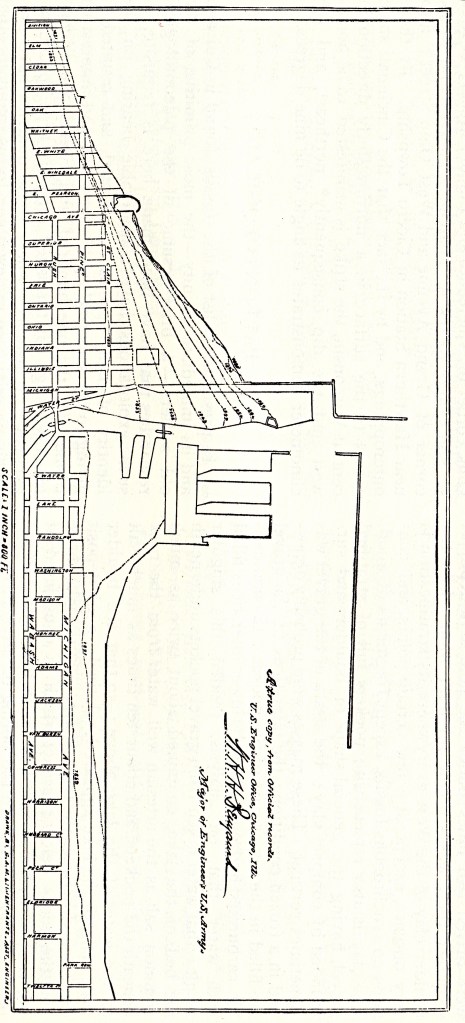
Ogden’s heroic, yet somewhat self-serving efforts were of little consequence to the nationwide malaise.  It was virtually impossible to sell any land in Chicago during 1838. Construction of the G&CU, which had just started in early 1837, was suspended in June 1837.  The railroad construction initiated throughout the state by the Internal Improvement Act of 1837, stretched fitfully into 1839 before it was halted by the legislature’s repeal of the act.  The political “wisdom” of starting all nine railroads simultaneously from both ends had left Illinois $6 million in debt with little to show for the expenditure except eventual state bankruptcy in 1842.  Although the Federal engineers under Lt. Davis had successfully opened a 200-foot-wide channel through the sandbar at the lake in 1834, it had been a continuous struggle to keep it clear of new sandbars created by the lake’s strong current.  The deposits against the north pier had pushed the shoreline north of the river’s original mouth some 700 feet eastward into the lake.  

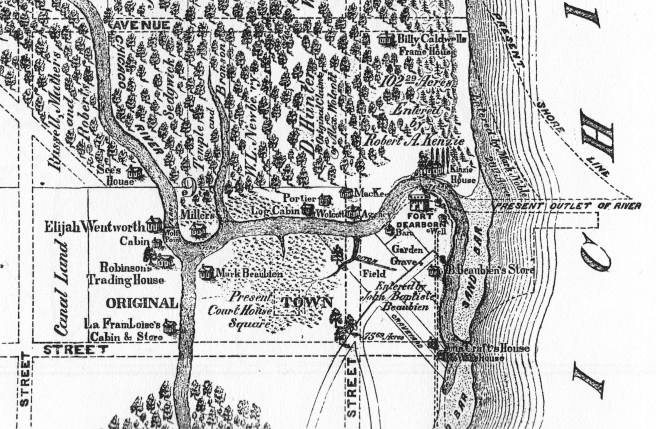
Map showing the growth of the sand deposits against of the north pier. (Andreas, History of Chicago-I)

By 1838, the piers had been extended over 1,800 feet into the lake at great cost and questionable effectiveness.  The financial panic caused Federal appropriations to be reduced to a level that attempted only to maintain what had already been completed.  At the start of 1839, even dredging operations had to be halted, and by April the newest sandbar had completely formed across the channel’s opening, preventing ships with draughts greater than eight and one-half feet from entering the harbor.  The only enterprise, therefore, that continued to pump needed cash into the city’s economy was the construction of the canal because the state funds earmarked for the canal had been kept separate from the railroad funds of the Internal Improvement Act.  However, even the canal’s contractors had to eventually make financial concessions to enable the canal work to continue until the state declared bankruptcy in 1842. Nonetheless, the expenditure of over $5 million during the six-year period of canal construction would greatly help Chicago to weather its first depression.

In the four hectic years since Chicago’s organization as a town, hundreds of buildings had been erected, the majority being located south of the river’s Main Branch.  All of these, with the exception of perhaps twenty brick structures, were constructed with wood, the majority of which had employed the new balloon framing technique.  One of the larger balloon-framed business blocks stood at the southwest corner of Lake and Dearborn.  It had a frontage of one hundred feet along Lake Street that had emerged as the principal commercial district by 1837. This was summarized by Andreas:

“Lake Street was well built up from State Street to Franklin.  The streets running north and south from the river were well-sprinkled with buildings.  A court-house, a jail, and an engine-house adorned the present square.  There were seven hotels and seven churches.  No church had a steeple, and, as one approached the city either from the lake, or south, out of the oak woods, no structure rose above the height of the chimneys of the town.  The city lay low down on the marsh ground,… and was to the sight of the new-comer, a most unsightly place to live, or even die in…  The speculation which had been rampant for the past three years was gone, but a grim determination showed in the lineaments of each true Chicagoan’s face, which meant that although fortunes had fled, Chicago was still left.”

While the Panic of 1837 did, indeed, stop Chicago’s adolescent growth in its tracks, the financial crisis was felt equally across the country.  Unfortunate as it was for the short-term financial viability of the new city, the Panic bought the one, most important commodity that Chicago needed for its long-term success at this precise moment that neither Chicago nor even William B. Ogden could buy: Time.  The time to catch up with Cincinnati, the largest economy and city west of the Appalachians, the time for the region’s new farmers to establish their farms, the time for the technology of the railroad to evolve, and the time during which the country’s politics began to critically divide the North and the South to a point beyond which it would be impossible for them to be united in the construction of a railroad, let alone a turnpike, that ran through the middle of the country from Washington, D.C. through Cincinnati and on to St. Louis, to which Chicago in the north and Memphis in the south could be linked by feeder lines.  All told, the Panic of 1837 would be a Godsend for Chicago’s future.

Further reading:

Adler, Dorothy R. British Investment in American Railways, 1834-1898. Charlottesville: University of   Virginia, 1970.

Andreas, Alfred T. History of Chicago, 3 vols. Chicago, 1884-1886. Reprint, New York: Arno Press, 1975.

Grant, H. Roger. The Louisville, Cincinnati, & Charleston Rail Road. Bloomington: Indiana University Press, 2014.Pierce, Bessie Louis. A History of Chicago- I. New York: Knopf.  1940.

Hidy, Ralph W. The House of Baring in American Trade and Finance. Cambridge: Harvard University Press, 1949.

Howe, Daniel Walker.  What Hath God Wrought: The Transformation of America, 1815-1848. New York: Oxford University Press, 2007.

Putnam, James William. The Illinois and Michigan Canal.  Chicago: University of Chicago Press, 1918.

(If you have any questions or suggestions, please feel free to eMail me at: thearchitectureprofessor@gmail.com)
3.17. CHICAGO INCORPORATES AS A CITY: OGDEN IS ELECTED AS THE FRIST MAYOR

In just three years from the approval of its charter, the town’s population had exploded from the original 350 to over 3,500 by the summer of 1836.  In order to begin a series of civic improvements, the town’s Board of Trustees had attempted to secure a loan but were rejected by the Chicago Branch of the State Bank of Illinois on August 5.  In response, the Trustees then named Ogden as Chicago’s fiscal agent, who immediately succeeded in negotiating a loan, probably through Bronson, allowing the town to embark on a series of sorely needed internal improvements.  Encouraged by its growing population (as well as by continual interference from the state in its local affairs), the Board of Trustees decided on November 18, 1836, to apply to the state legislature to incorporate Chicago as a city.  A committee of five: two members of the Board of Trustees, Ogden and Peter Bolles, who was also the president of the Chicago Marine and Fire Insurance Company, and a citizen representing each of the town’s three districts, Ebenezer Peck, Theophilus Smith, and John D. Caton, was appointed to draft the city charter.  Attorney Caton had arrived from Monroe County, New York, in 1834, destined to be appointed to the Illinois Supreme Court in 1844.  Thus, railroad supporters (Ogden, Peck, and Smith), as well as the president and two directors of Chicago Marine and Fire Insurance (Bolles, Peck and Smith), comprised a majority of the committee that ultimately framed Chicago’s city charter that was submitted to the state legislature.

Undoubtedly, the enthusiasm behind these development plans had been encouraged not only by Pres. Jackson’s banking program and policy of Western expansion, but also by the very extensive plans the state was drafting for internal improvement.  President-Elect Martin Van Buren had signaled his intensions to continue the growth policies of Jackson.  True to the spirit of the times, Illinois’ Internal Improvement Act, passed by the legislature on February 27, 1837, was intended to establish a comprehensive transportation system throughout the entire, thinly populated state.  A $4 million loan was guaranteed to allow construction of the Chicago canal to continue, and adjacent rivers and creeks were to be made navigable to extend the water routes throughout the state.  However, even more funding, $9.65 million was allotted to a separate fund for the construction of a proposed 1,340-mile network of nine railroads.  Of this, $3.5 million was earmarked for the IC that was to be extended to Galena, thereby completing the “St. Louis Cut-off.”  To avoid any sectional bickering that could stall the start of construction, the law incredulously stated that all nine of the railroads were to be started at both ends simultaneously.

It was during this initial period of euphoric intoxication that the legislature approved Chicago’s city charter on March 4, 1837, only five days after the passage of the Internal Improvement Act.  The city’s leading Democrats, Francis Sherman, Peter Pruyne, and “Long John” (he was 6’-6” tall) Wentworth, the acting-publisher of the Chicago Democrat, the city’s first newspaper, asked Ogden to run as the Democratic candidate against Whig John H. Kinzie in the city’s first mayoral election.  Wentworth was a Dartmouth-educated, pro-Jackson/Van Buren newspaper writer originally from New England who had moved to Chicago, seeking his fortune, having arrived on October 25 of the previous year.  He had accepted the position as the paper’s “Agent” for the Democrat’s owner, an acquaintance from his home state of New Hampshire who had been forced to return home, leaving Wentworth, for practical purposes, in charge of its editorial policy.  The first popular election of the new city’s Mayor was set for the first Tuesday in May, May 2, 1837, and its outcome reflected the city’s economic transition as Ogden, the representative of the East Coast American Land Company, easily defeated Kinzie, the old town’s favorite son who had been a former agent of the American Fur Company.  In the span of only one year, William Ogden had managed to become the leader of the new city’s 4,170 residents, a feat of which recently-elected Pres. Martin Van Buren would have been very proud.  The new Mayor took the oath of office on the following day, and six days later initiated Van Buren’s patronage program that had been perfected in New York state politics by rewarding Wentworth for his support when Common Council made the Democrat the city’s official newspaper.  A month later Ogden also named Wentworth as the city’s printer.  Ogden placed a new but trusted friend, lawyer Isaac Newton Arnold, in the important position of City Clerk.  Arnold was born in Hartwick, NY, and had studied law in Cooperstown, NY, before moving to Chicago in late 1836.  It did not take long for Arnold to strike up a friendship with Mahlon Ogden that led to their mutual professional partnership that eventually would be responsible for the Mayor’s legal affairs.  Arnold had made his first acquaintance with the future Mayor in St. James Church in the spring of 1837. Keeping one’s business within the control of one’s family had been a very common New England business practice since the founding of the colony.  While it provided lucrative employment for family members, it also allowed the family leader to control business decisions and keep them from the prying eyes of the public.  Ogden would use this technique, combined with Van Buren’s patronage system, extensively to his advantage during his long and successful career in his adopted hometown.

3.18. CHICAGO’S FIRST ARCHITECT: JOHN MILLS VAN OSDEL

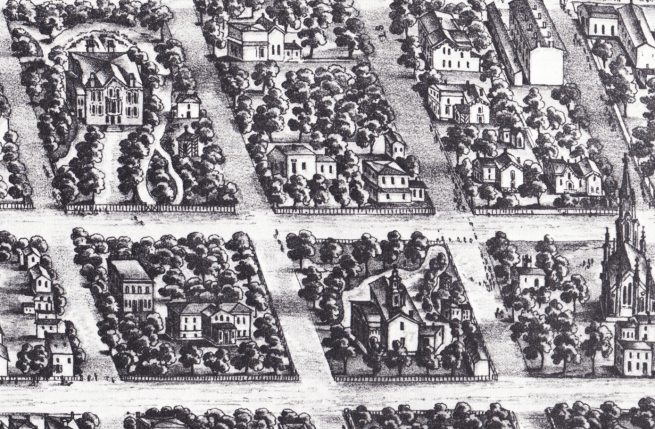
John Mills Van Osdel, William B. Ogden House, block bounded by Erie, Rush, Ontario, and Cass Streets, 1837. (Vernon, Graceland)

Proof of Ogden’s decision to restart his life by moving to Chicago is evident in his hiring of an architect to design a new house for him in Chicago during a return visit he made to New York in the fall of 1836, prior to his successful election as Mayor.  Ogden needed an impressive edifice not only to encourage potential real estate clients, but also to comfortably house the many members of his extended family for which still he felt responsible.  During his return trip to New York to prepare for his move to Chicago, it appears he had already planned to accept the mayoral nomination, if so offered, of the city for which he had helped to write its City Charter,  for he searched for a designer-builder where he came upon twenty-five year-old John Mills Van Osdel.  Van Osdel was the son of a carpenter and while working for his father in New York City, had read about architectural design and construction in the city’s Apprentice Library.  Ogden  hired him to design and ultimately supervise the construction of a house north of the river on the block bounded by Ontario, Rush, Erie, and Cass (now Wabash).  Not wanting to raise any eyebrows before the election, Ogden apparently had told Van Osdel to keep the project secret.  Before Van Osdel set out for Chicago following the mayoral election, he completed the drawings and had all of the millwork and windows manufactured in New York and then quietly shipped to Chicago during the spring of 1837.   Van Osdel prudently did not come to Chicago to erect the house until June 9, a month after Ogden had been elected Mayor.  Van Osdel produced a two-story Greek Revival design, that became known as “Ogden Grove” that incorporated four two-story high columns in its great south-facing portico on Ontario.

Van Osdel, William B. Ogden House, block bounded by Erie, Rush, Ontario, and Cass Streets, 1837. Diagonally to the lower right is Isaac N. Arnold’s house. (Bluestone, Constructing Chicago)

Upon his arrival, Chicago’s first architect had quickly come face-to-face with the harsh reality of building in Chicago:

“He noticed a block of three buildings, three stories high, the fronts of which had fallen outward, and laid prone upon the street.  Upon inquiry he found that the frost of the preceding winter had penetrated to a great depth below the foundations, and the buildings have a south front, the sun acting upon the frozen quicksand under the south half of the block rendered it incapable of sustaining the weight of the building.  At the same time, the rear, or north part of the block, being in shadow, the frozen ground thawed gradually, and continued to support the weight resting upon it.  The consequence was that the block careened.  The front settled fourteen inches more than the rear, making all the floors fourteen inches out of level from front to rear.  This movement pressed the upper part of the front wall outward beyond its center of gravity, and it fell to the ground.  The rear wall inclined upward twelve inches, but resting against the party walls and floors, remained intact.”

Further reading:

Andreas, Alfred T. History of Chicago, 3 vols. Chicago, 1884-1886. Reprint, New York: Arno Press, 1975.

Arnold, Isaac N. “William B. Ogden: and Early Days in Chicago,” Fergus Historical Series, No, 17. Chicago: Fergus, 1882.

Ericsson, Henry L. Sixty Years a Builder: The Autobiography of Henry Ericsson. Chicago: A. Kroch,  1942.

Gilbert, Paul T., and Charles L. Bryson. Chicago and Its Makers. Chicago: F. Mendelsohn, 1929.

Harpster, Jack. A Biography of William B. Ogden. Carbondale: Southern Illinois University, 2009.

Pierce, Bessie Louis. A History of Chicago-I. New York: Knopf.  1940.

(If you have any questions or suggestions, please feel free to eMail me at: thearchitectureprofessor@gmail.com)
3.16. OGDEN MOVES TO CHICAGO 

Charles Butler’s efforts to bring his brother-in-law out of his depression appear to have been successful, for following Ogden’s return to his native Walton, NY, after having completed the sale of Butler’s lots in the summer of 1835, he seems to have decided to start a new phase of his life by moving the majority of his family, for whom he had been financially responsible since his father’s initial stroke in 1821, to Chicago.  In William Butler Ogden, the new town was gaining what any city needed to grow into an important political and economic entity: a successful, resourceful, shrewd, and experienced thirty-year old businessman, a proponent of railroads who had deep pockets and powerful political connections, that following Martin Van Buren’s election as President in the coming November, reached all the way to the White House, via the Albany Regency’s Democratic patronage machine.  Ogden would help to build the city and, correspondingly, reap the appropriate benefits of doing so, for as we will see, what was good for Chicago, would also be good for William Butler Ogden.         

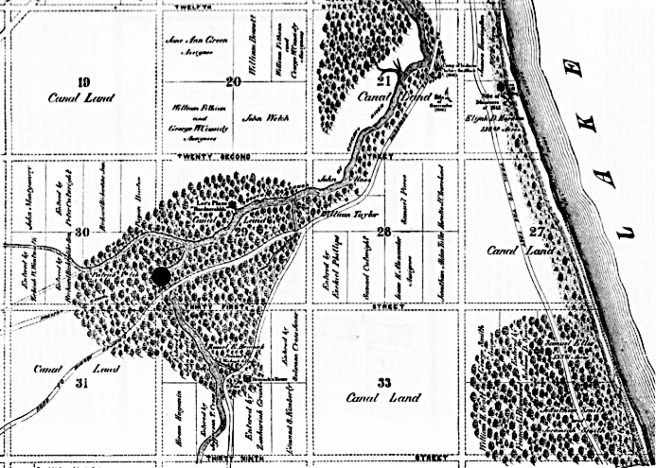
He made his return trip to Chicago with his younger brother, Mahlon, late in the spring of 1836, in order to procure one of the canal’s construction contracts. While William had forgone his youthful hopes of becoming a lawyer due to the death of their father, he had made sure that younger Mahlon would succeed in becoming an attorney.   After Mahlon had completed his law studies back home in Geneva, NY, the Ogdens’ political connections with the Jackson administration had secured him a clerk position in the office of Noah Haynes Swain, then the U.S. District Attorney in Columbus, OH.   Mahlon had accompanied Charles Butler on his return visit the prior year to the NorthWest and was eager to join his older brother in carving out a new life in Chicago.  In order to encourage the success of the upcoming June 20 sale of canal lots, the canal commissioners had awarded the first construction contracts for the Chicago, or Summit, Division of the canal on June 6, 1836, just two weeks prior to the land sale.  Ogden, in partnership with one of his Walton business partners, Harry Smith, who had married one of Ogden’s cousins, a daughter of Ogden’s Uncle Daniel, was awarded a $200,000 contract to build a portion of this section of the canal.  Finally, on July 4, 1836, a grand parade from the Public Square to Canalport where the canal was to begin (the corner of Ashland and 29th), marked the official start of the project.  Judge Theophilus Smith opened the dedication ceremonies by reading the Declaration of Independence.  Following the usual speeches and groundbreaking by local dignitaries, the proceedings ended with a closing address by current Canal Commissioner Gurdon Hubbard.

Map of Bridgeport (originally Canalport), the start of the I & M Canal at Ashland and 29th (dot). (Andreas, History of Chicago-I)

The same day that Ogden had been awarded one of the canal contracts, he was also elected to the town’s Board of Trustees that led to his long-time relationship with the town’s Clerk, Ebenezer Peck, one of the G&CU’s founders.  At about the same time, Ogden established his real estate management company, the Ogden Land and Trust Agency as an agent for Eastern land speculators, in a small building in the North Division on Kinzie near State Street.  Contrary to the majority of Chicago’s land speculators, Ogden preferred property in the city’s North Division to that in the South, as did other businessmen who did not have their primary place of business located in the South Division.  From here, Ogden would manage the investments of not only Butler’s American Land Company, but would expand his own clientele to nearly 100 investors, who were primarily located along the East Coast.

Further reading:

Andreas, Alfred T. History of Chicago, 3 vols. Chicago, 1884-1886. Reprint, New York: Arno Press, 1975.

Harpster, Jack. A Biography of William B. Ogden. Carbondale: Southern Illinois University, 2009.

Kogan, Herman and Lloyd Wendt. Chicago: A Pictorial History. New York: Bonanza Books, 1958.

Masters, Edgar Lee. The Tale of Chicago. New York: Putnam, 1933.

Putnam, James William. The Illinois and Michigan Canal.  Chicago: University of Chicago Press, 1918.

Scammon, J. Young. “William B. Ogden,” Fergus Historical Series, No, 17. Chicago: Fergus, 1882.

Tallmadge, Thomas Eddy. Architecture in Old Chicago, Chicago: University of Chicago Press, 1941.

(If you have any questions or suggestions, please feel free to eMail me at: thearchitectureprofessor@gmail.com)

3.13. EARLY ATTEMPTS AT ARCHITECTURE: THE FIRST COURTHOUSE

Chicago’s First Courthouse, southwest corner of Clark (left) and Randolph (right), 1835. The courthouse was probably the first building in Chicago with any architectural pretensions, for its design echoed the then prevalent Greek Revival style, even though its overall massing was based on that of a Roman Temple. At the right midground is located the jail and enginehouse erected in 1833. (Andreas, History of Chicago-I)

The overwhelming success of the initial land sales and the exploding rate of newcomers entering the city seemed to signal that Chicago was going to survive as a western settlement.  Appropriately, it was now time to start constructing buildings not as just quick, expedient shelter, but as buildings in a material more suitable for such architectural aspirations that spoke of a secured and long-lasting future: masonry.  In the fall of 1835, construction began on the Public Square of the County Courthouse at the southwest corner of Randolph and Clark, establishing Randolph Street, one block south of busy, commercial Lake Street, as a quieter location for offices.  A log blockhouse erected in 1833 that was used as a jail was already standing on the Square at the southeast corner of Randolph and La Salle, opposite the site of the planned structure.  The Courthouse was probably the first building in Chicago with any architectural pretensions, for its design echoed the then prevalent Greek Revival style, even though its overall massing was based on that of a Roman Temple.  A courtroom that seated 200 was elevated above a basement in the brick body of the 30′ by 60′ building.  Office space was located in the basement for the county government.  To enter the courtroom, one mounted a flight of stairs and passed under a wooden portico of four Doric columns that faced onto Clark Street.

The Saloon Building, southeast corner of Lake (left) and Clark (right), 1836. (Andreas, History of Chicago-I)

While the county was provided office space in the basement of the Courthouse, the town’s government, such as it was in 1836, had to look elsewhere for space.  This was admirably provided in 1836 with the erection of the three-story Saloon Building by J.B.F. Russell and G. W. Doan, one block north of the Courthouse on Clark Street at the southeast corner of Lake Street.  Once again, an air of permanence was sought with the use of masonry on its exterior.  Stores were located on the ground floor, while the second floor contained offices.  It was the third floor that contained a large hall from which the building derived its name.  ‘Saloon’ originally had nothing to do with our current conception of a western tavern, but came from the French term, salon, interpreted by the building’s owners as a spacious and grand room.  Many of early Chicago’s important political meetings and famous social events took place in the Saloon’s hall until even larger and more commodious facilities were constructed in the 1850s.

3.14. THE FIRST HOTELS

In addition to these two governmental institutions, the first major private building type that demanded the increased architectural attention of masonry was the hotel.  With the onslaught of newcomers arriving in Chicago during 1835 and 1836, demand for temporary shelter constantly outpaced the city’s inventory of rooms for rent.  Prior to 1835, the two leading suppliers of nightly accommodations were the landmark Sauganash Inn at the southeast corner of Lake and Market and the first Tremont House, erected in 1833 at the northwest corner of Lake and Dearborn by Alanson Sweet.  He had named it after the Tremont House in Boston that was famous for being the first American hotel to have both running water and indoor plumbing. (This was designed by Isaiah Rogers in 1829.)  Neither of these early local structures could legitimately claim to be “hotels,” however, because of their diminutive size and rustic service.  A more accurate description for all of Chicago’s similar buildings at this time would be rooming house or “inn.”  In the fall of 1835, however, construction began on what Chicago could justly call a hotel, the four-story Lake House.

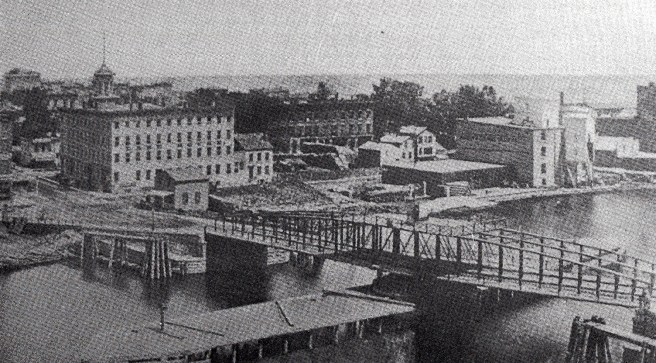
The Lake House Hotel, southeast corner of Rush and (old) Michigan, 1835. The Rush Street swing bridge is in the foreground. (Karamanski, Rally ‘Round the Flag)

Built by a group that included John H. Kinzie and Gurdon Hubbard, in the more fashionable North Division now accessible with the completion of the Dearborn Street drawbridge, it was located across from the fort where the river took a southern dogleg at the southeast corner of Hubbard (then Michigan) and Rush Streets, and was thus located to look directly downriver to the lake at the new cut in the sandbar that allowed the river to run straight into Lake Michigan.  Hence, the Lake House was positioned to take immediate advantage of new visitors arriving from lake schooners, as well as farmers who parked their prairie schooners across the river on the fort’s reservation.  Constructed with an exterior of brick, the Lake House was touted when it opened in the fall of 1836 as the “best hotel in the West,” having brought to Chicago such extravagances as napkins and printed menus. 

The year 1836 also saw the start of construction of a second brick hotel: the three-story City Hotel.  It was owned and operated by Francis Cornwall Sherman, a local brick manufacturer who had moved to Chicago in April 1834.  He wisely located the hotel on the northwest corner of Randolph and Clark, right in the middle of the city’s emerging governmental district: directly across Randolph from the Courthouse and only a half block down Clark from the Saloon Building. Sherman, who had started out as a brickmaker, would rise within the ranks of the Democratic Party to be elected Mayor in 1841, and again in 1862.  Just north of the City Hotel on Clark Street the city’s first post office was erected.

3.15. ST. JAMES PRESBYTERIAN AND THE ENGLISH “GOTHICK” REVIVAL

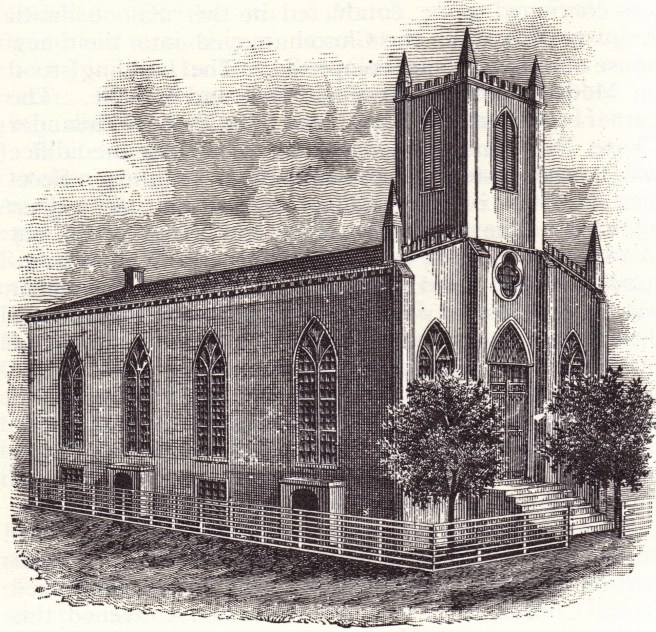
With government and private owners starting to utilize masonry construction in 1835-36, it was only a matter of time (and money) until a local congregation would incorporate brick in the erection of a new church.  This occurred in 1836-37 with the construction of St. James Episcopal Church on a lot, in the North Division, donated by John H. Kinzie that was located on the southwest corner of Wabash (then Cass) and Illinois, between Hubbard (then Michigan) Streets.  Kinzie apparently also footed much of the cost of construction, that permitted the use of the more ostentatious (and expensive) brick for the exterior of the 44′ by 64′ building.  In contrast to the Greco-Roman Courthouse, St. James was given a more appropriate English “Gothick” Revival (as this predated by a few years the writings by British architect Augustus Welby Pugin that identified the architectural qualities of an authentic Gothic Revival: exterior, including pointed arched windows, crenellations, finials, and a square, flat-roofed bell tower.  “The English church authorities labored to counteract the growth of the national Renaissance and built after the forms obtained in England during the seventeenth century, so that in 1837 Chicago’s villagers had a grotesque Doric house on one side of the river, and a grim, perpendicular Gothic house on the other, telling in wood and brick that architectural ideas were alive and would some day grow and flourish here.”

St. James Episcopal Church, on Cass (now Wabash), just south of Illinois, 1836. (Andreas, History of Chicago-I)

FURTHER READING:

Andreas, Alfred T. History of Chicago, 3 vols. Chicago, 1884-1886. Reprint, New York: Arno Press, 1975.

Industrial Chicago.  Vols. 1 and 2, The Building Interests. Chicago: Godspeed, 1891-1896.

Karamanski, Theodore J. Rally ‘Round the Flag: Chicago and the Civil War, Chicago: Nelson-Hall, 1993.

Masters, Edgar Lee. The Tale of Chicago. New York: Putnam, 1933.

Pierce, Bessie Louis. A History of Chicago- I. New York: Knopf. 1940.Stoddard, Francis Hovey. The Life and Letters of Charles Butler. New York: Scribner: 1903.

Tallmadge, Thomas Eddy. Architecture in Old Chicago. Chicago: University of Chicago Press, 1941.

(If you have any questions or suggestions, please feel free to eMail me at: thearchitectureprofessor@gmail.com)

3.11. WILLIAM OGDEN IS SENT TO CHICAGO

I consider William Ogden to be “The Man who made Chicago Chicago,” so it is central to my story to understand Ogden’s background before his move to Chicago. As Arthur Bronson’s associate, Charles Butler, returned home following his inspection of the proposed canal, he had more pressing personal concerns.  He had married Eliza Ogden, the oldest of five children in a family from Walton, NY, in 1825.  The older of her two brothers, William, (born 1805) had been forced at the age of sixteen in 1821 to take over the management of his father’s businesses, that included a number of timber, flour, and woolen mills, after their father first suffered a stroke and then had died some two years later.  William had been quite successful in building up the businesses, especially in the face of competitors in the northern section of the state who had gained an economic advantage with the completion of the Erie Canal.  He felt sufficiently financially secure in 1829 to finally ask his childhood sweetheart, Sarah North, to marry him, but she subsequently succumbed to pneumonia not long after she had accepted his proposal.  Ogden had since languished in depression over the past three years from the loss of his one true love, going aimlessly through the motions of life without any real interest in the future.  No one knew this better than his sister Eliza and her husband Charles, who was about to attempt to jumpstart his brother-in-law’s passion for life.  

In his biography of William Ogden, Jack Harpster made a convincing argument that Butler’s attempt to restore the purpose in Ogden’s life was to have ramifications way beyond those of his original objective.  The New York & Erie Railroad had lain stillborn since its initial charter by the New York Legislature in April 1832.  The 1832 Presidential election had elected Martin Van Buren as Pres. Jackson’s Vice-President.  Van Buren’s law partner, Charles’ older brother Benjamin, would be named in November 1833 to replace Roger Taney as the U.S. Attorney General following Taney’s failure to be confirmed as the Treasury Secretary by Jackson’s opponents in the Senate as a rebuff to the President’s unilateral action against the Second Bank of the United States (2BUS).  Following his election, Vice-President Van Buren, still the leader of the Albany Regency political machine, was now committed to getting the State legislature to approve an additional loan guarantee so that construction of the Erie Railroad could begin, that had so far languished in committee due to the influence of politicians along the route of the Erie Canal who opposed the railroad in the south.  Ogden had experienced, firsthand, the economic changes wrought by the Erie Canal, to which he had no geographic access, while a railroad in the southern portion of the state would offer similar advantages to his property and restore his economic competitiveness.

Harpster had reconstructed the events that led to Van Buren and Benjamin Butler to identify Ogden, obviously through the recommendation of Charles Butler, to be the man to run for the State Assembly during the upcoming 1834 election so that he could make a speech during the 1835 session that might turn the tide in favor of the Erie Railroad.  Harpster speculated that Charles had invited his moribund brother-in-law to a secret meeting somewhere in the Hudson Valley during 1833, that included his brother and Van Buren, in which the Vice President “made him a deal he couldn’t refuse:” that he run for the Assembly seat from Delaware County under Van Buren’s Democratic Party. Charles knew that Ogden would have no real alternative but to agree, hoping that the political campaign would reignite the twenty-eight year old’s lust for life.  Ogden was successful in the 1834 campaign, but before he was to deliver his speech in the Assembly on March 21, 1835, the Erie’s opponents had forced the vote to be rescheduled a day earlier, in which they once again rejected any further funding for the Erie.  Unbowed, Ogden still stood in the Assembly the next day and delivered his reasoning for such funding: 

“The importance of proceeding without delay… must be apparent to every one; for if the business of the western states should be diverted from us, [by the railroads then being constructed by New York’s competing ports] it would be difficult, if not impossible, to regain it by any subsequent exertions… I see continuous railways from New York to Lake Erie… and south through Ohio, Indiana, and Illinois to the waters of the Mississippi, and connecting with railroads running to Cincinnati and Louisville in Kentucky, and Nashville in Tennessee, and on to New Orleans.  They will present the most splendid system of internal communication ever devised by man.”

Although the issue had been defeated the day before, Ogden’s speech had the effect Van Buren had hoped for in that the funding for the Erie was approved by both houses in the upcoming fall session.  

Meanwhile, Charles Butler, after his trip with Bronson to Chicago in 1833, appears to have become fixated on real estate speculation, contrary to his earlier nature, and in February 1835 purchased Bronson’s 182 acres in Chicago along the north bank of the river for $100,000 (a 400% profit) with funds he had obtained collectively from a group of seven friends that included his brother as well as his brother-in-law.  He then relocated from Geneva, NY, to New York City and organized the American Land Company, of which he placed himself as president.  He then initiated the second phase of his campaign to reignite his brother-in-law’s purpose in life: he asked Ogden to travel to Chicago in order to prepare the land for sale and to supervise its sale in May 1835 after the Federal government started auctioning the newly-acquired Native lands, and in June when the state was to commence selling canal lots, hoping these two events would generate a large crowd of interested speculators. Having performed the sole task that he had been asked to do by the Vice President, Ogden resigned his Assembly seat so that he could travel to Chicago in May 1835 so that he could manage the sale of the land that his brother-in-law had bought from Bronson.

3.12. THE CANAL LAND BOOM

Ogden arrived in Chicago in late May 1835 and first met with Bronson’s brother, Frederick, who had been sent to Chicago by his older brother before he had made the decision to sell the land to Butler, to legally transfer the title of the property at the Federal Land Office on Lake Street, near Clark. Ogden then set about preparing, albeit somewhat skeptically, the property for auction. The standard method of land speculation at the time was to purchase the land with a minimum down payment, using a mortgage to finance the balance of the transaction. Once the land had increased in value, a portion of the original real estate was resold at the higher value in order to discharge the mortgage, leaving the purchaser in sole ownership of the remaining land without any cost to himself, for all practical purposes, the speculator would gain ownership of the land at no cost. Ogden was astonished when he had sold only one-third of the land, because he had already recouped the entire purchase price. Fired by the optimism generated by the new canal bill and funded by Jackson’s distribution of Federal monies to regional banks that was part of his battle plan with the 2BUS, the town’s land prices had gone wild with speculation. What Bronson had bought in the summer of 1834 for $20,000 would be worth $500,000 two years later in September 1836.

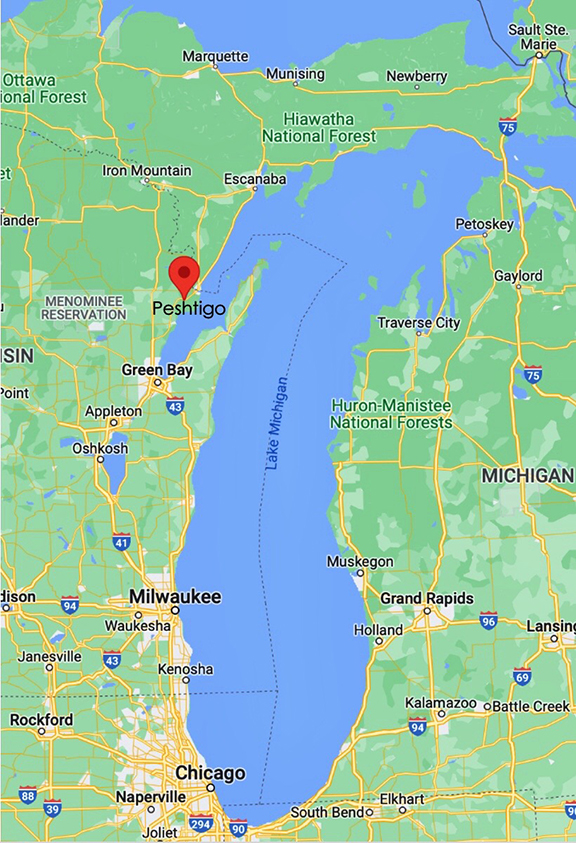
Before Ogden started his return trip to New York, however, he made a quick inspection trip up Lake Michigan and into Green Bay, finally stopping at Fort Howard, WI, located at the mouth of the Fox River into Green Bay (the town of Green Bay would not be incorporated until 1854). He had heard talk of the timber resources in upper Wisconsin and wanted to see for himself if the area had any real timber investment potential. With his lumber experience he would have pleasantly smiled as the steamboat plied the wooded shores of Green Bay. This may have been the final event that convinced Ogden to move to Chicago and begin a new phase of his life, for over time, he would own most of the forests in the area that centered around the small lumber company town that he would build and name Peshtigo, Wisconsin. On his return trip to Chicago, he made the acquaintance of two men who would become his oldest friends and business associates, Walter Newberry, Bronson’s land agent in Chicago, and lawyer J. Young Scammon. Scammon was a twenty-three year-old lawyer from Maine who was moving to Chicago to make his fortune. Within a week of his arrival, Scammon was hired as the deputy of the circuit court clerk.

FURTHER READING:

Adler, Dorothy R., British Investment in American Railways, 1834-1898, Charlottesville: University of Virginia, 1970.

Andreas, Alfred T. History of Chicago, 3 vols. Chicago, 1884-1886. Reprint, New York: Arno Press, 1975.

Arnold, Isaac N. “William B. Ogden: and Early Days in Chicago,” Fergus Historical Series, No, 17. Chicago: Fergus, 1882.

Harpster, Jack. A Biography of William B. Ogden. Carbondale: Southern Illinois University, 2009.

Milton, George Fort, The Eve of Conflict: Stephen A. Douglas and the Needless War, New York: Octagon, 1969.

Pierce, Bessie Louis. A History of Chicago- I. New York: Knopf. 1940.

Stoddard, Francis Hovey. The Life and Letters of Charles Butler. New York: Scribner: 1903.

(If you have any questions or suggestions, please feel free to eMail me at: thearchitectureprofessor@gmail.com)
3.8. THE CANAL IS FINALLY APPROVED BY THE STATE

By no means, however, were Chicago’s leaders in general agreement on the canal issue.  Apparently responding to the State’s ambivalence over whether to build a canal or a railroad at Chicago, Bronson also joined with local leaders John H. Kinzie (Robert’s older brother), Gurdon Hubbard, George Dole, and State Senator Peter Pruyne, who were more than likely inspired by the state’s “Central” railroad scheme and had decided to cover their canal bet by submitting a proposed charter for Chicago’s first railroad, the Chicago & Vincennes (C&V) Railroad. It was slated to run directly from Chicago south along the Illinois/Indiana border to the Wabash River at Vincennes in southwestern Indiana, thereby making a similar connection to the Mississippi, but threatening to bypass most of the interior towns in Illinois along the canal route.  Suspiciously, the General Assembly approved the C&V charter on January 17, 1835, thus posing a serious threat to the proposed canal and the towns along its route.  

The railroad scheme evidently accomplished its sole intended purpose of getting the legislature to act on the canal, for once the representatives from the canal towns succeeded in getting the legislature to pass a new canal bill on February 10, 1835, less than a month after the approval of the railroad’s charter, the same four Chicago men abandoned the railroad scheme and organized Chicago’s first bank, the Chicago Branch of the State Bank of Illinois, in anticipation of the boom to come from the start of the canal’s construction.  The canal bill set the dimensions of the canal at 45’ wide at its surface and 30’ at its base, with a depth sufficient for boats with 4’ drafts.  It also authorized the Governor to negotiate both a $500,000 loan to begin construction, and to issue bonds using the canal land grant and future tolls as security, to sustain the project through to completion.  Governor Duncan immediately began corresponding with New York financiers through Bronson and sent former Governor Edward Coles to negotiate a loan with the Rothschilds in Europe.  His efforts proved premature, for Bronson replied to Coles that potential lenders were leery of such an undertaking and wanted assurances that the State would guarantee the loans even if the project failed.

3.9. USING THE THREAT OF A RAILROAD TO FORCE THE CANAL ISSUE: THE IC AND THE G&CU

All this speculative activity, however, was predicated on the assumption that the canal would be successfully completed, which in 1835 was by no means a foregone conclusion.  Sectional jealousies in the state legislature were hindering both the planning for the canal in the North, as well as all efforts to fund the initial surveys for the “Central Railroad” in the South.  Studying the chronology of events in 1835, it appears that the push for the Cincinnati & Charleston Railroad began by Dr. Drake on August 10, with the corresponding chartering of the company in the four states it was to pass through, and then the Charleston resolution of October 22, got the attention of those in Illinois debating this issue and in October 1835, Josiah Sidney Breese, in order to transcend local bickering, proposed to marry the two projects into one grand scheme that would benefit all of the state, to the detriment of St. Louis. Breese was one of Illinois’ “founding fathers” in that he had been brought to Illinois following his graduation from Union College in New York in 1818 by his childhood friend, Elias Kane, who had been named as the new state’s first Secretary of State, to be his assistant.  Breese had completed his legal training in Illinois and was admitted to the bar in 1820.  In 1827, he had been named by Pres. Adams as the U.S. State’s Attorney.  In 1835, when he made his proposal to merge the Central Railroad with the canal, he had just been named as a Judge in Illinois’ Second Circuit.  His proposal for the railroad was not as altruistic as it may appear on the surface, however, for Breese had joined with Darius B. Holbrook, a Bostonian investor, in purchasing land at the junction of the Mississippi and the Ohio, with an eye towards speculating on the construction of a town they planned to name Cairo.

Breese echoed Bronson’s statement that Eastern investors would require the State of Illinois to guarantee any canal construction bonds and suggested that the credit of the state be used to complete both projects and that construction of both should start at the same time.  The inherent logic of his proposal was irresistible, and it took only three months for supporters to get the legislation passed that chartered the Illinois Central (IC) Railroad on January 18, 1836.  Just two days earlier on January 16, 1836, the legislature had chartered another railroad, the Galena & Chicago Union (GCU).  From exposure to the earlier Central Railroad proposal, Chicago lawyers Ebenezer Peck, the town’s clerk, and Judge Theophilus W. Smith, a former (1823) canal commissioner, understood the railroad’s potential to increase land values, and planned a railroad from Chicago northwest to the Mississippi River at Galena, the center of the region’s lead mining.  At this time, Galena, was much larger in population and appeared to have a brighter future than Chicago, consequently Galena appeared first in the railroad’s name.  This proposal can also be seen as another branch of the “St. Louis cut-off,” for with the completion of the G&CU, Galena’s lead as well as farm products from the states in the upper Mississippi Valley, would need to be shipped downriver along the Mississippi only as far as Galena, and then transferred to rail for the trip to Chicago, from where they would be shipped via water to New York, thereby completely bypassing St. Louis and New Orleans.

Although Galena was just within Illinois’s northern border, many of the lead mines in the area were across the border in Wisconsin, and Wisconsin viewed the region and its riches as its own.  As both the Rock and Wisconsin Rivers provided transport from the Mississippi that, combined with a number of portages, could reach Lake Michigan, it was logical that a canal or railroad could be built that would link the lead region to Green Bay so that the route (and its corresponding transportation cost) that its lead would have to travel to the East would be significantly reduced from its traditional path down the Mississippi and around Florida.  Geographer Henry Schoolcraft had been the first to propose such a canal to Green Bay in 1831.  By 1836, however, the small settlement of Milwaukee had grown in importance to suggest that instead of a canal to Green Bay, a railroad from the Mississippi directly to Milwaukee’s harbor on Lake Michigan made more sense, for the same reasons that Illinois’ railroad advocates were making.  In fact, Wisconsin had barely beaten Illinois to the first punch over Galena as Wisconsin’s territorial government had approved a memorial to Congress requesting funding for a canal from the Mississippi to Green Bay, only three days before Illinois granted the charter for the G&CU Railroad.

3.10. THE CANAL COMMISSIONERS SET ASIDE THE LAKEFRONT TO BE A PARK FOREVER

The initial plans for both the IC and the G&CU were intimately connected with the construction of the Chicago canal, for they were chartered within a week of the passage of another canal bill by the state legislature on January 9, 1836.  Sales of canal construction bonds, along with the plans for the canal, had been languishing until this bill was passed that responded to the concerns of Eastern lenders by authorizing the credit of the state to guarantee the canal bonds.  This bill also appointed the canal’s third Board of Commissioners (Gurdon Hubbard, William F. Thornton, and William B. Archer) and William Gooding as its chief engineer.  The canal’s dimensions were optimistically increased to 60’ wide at its surface, 36’ wide at its base, with a depth of 6.’  Once this bill was passed, sales of the bonds increased sufficiently to pay for final surveys and estimates by Gooding.  The new canal commissioners set the date of June 20, 1836, for the second public sale of canal lots.  Fortunately for the generations of Chicagoans to come, the three commissioners also had the foresight to set aside the canal land along the lakefront west to Michigan Avenue that lay between Madison and 12th Street to be dedicated as a public park.  

Ill. and Mich. Canal Commissioners Map, July 2, 1836. “Public Ground: A Common to remain forever Open, Clear, & Free of any buildings, or other obstructions Whatever.” (Online)

On their map appeared the following inscription along the lakefront: “Public Ground-A Common to Remain Forever Open, Clear and Free of any Buildings, or other Obstruction Whatever.”  This most fortuitous act may have been in response to a petition signed during the previous November by Chicago’s leading citizens and sent to the Federal government.  In it, they had asked that the government, in closing down the now useless and deteriorating Fort Dearborn, dispose of the fifty-four acres of prime lakefront real estate upon which it sat in the following manner: the thirty-four acres that lay between the south bank of the river and Randolph Street should be auctioned and the profits used to finance a variety of public improvements, while the remaining twenty acres that sat between Randolph and Madison should be made into a public park that fronted on the lake.  The impetus for such a proposal may have been the start of construction of the Courthouse, that was going to remove a portion of the public square from public use that at the time was the only public open land available for recreation.  No matter the reason for why the commissioners had set aside the lakefront property, this one action, unquestionably, more than any other in the city’s history, would have the greatest impact upon Chicago’s urban landscape.

FURTHER READING:

Andreas, Alfred T. History of Chicago, 3 vols. Chicago, 1884-1886. Reprint, New York: Arno Press, 1975.

Bluestone, Daniel. Constructing Chicago. New Haven: Yale University Press, 1991.

Grant, H. Roger. The Louisville, Cincinnati, & Charleston Rail Road. Bloomington: Indiana University Press, 2014.

Harpster, Jack. A Biography of William B. Ogden. Carbondale: Southern Illinois University, 2009.

Lorenzsonn, Axel S. Steam and Cinders: The Advent of Railroads in Wisconsin: 1831-1861.  Madison: Wisconsin Historical Society Press, 2009.

Pierce, Bessie Louis. A History of Chicago- I. New York: Knopf.  1940.

Wille, Lois. Forever Open, Clear, and Free; The Struggle For Chicago’s Lakefront. Chicago: Regnery, 1972.

(If you have any questions or suggestions, please feel free to eMail me at: thearchitectureprofessor@gmail.com)
3.7. THE FIRST CHURCHES

As many of the city’s initial settlers had moved north into the region from southern Illinois, a Methodist circuit was established that brought Methodist preacher Jesse Walker to Chicago on a regular basis as the town’s first representative of organized religion.  In 1831, Stephen Beggs was assigned to the local congregation as Chicago’s first resident minister to be joined the following year by Walker.  Subsequently, the increased rate of settlement in early 1833 had also brought enough Roman Catholics to Chicago that they successfully petitioned the Bishop of St. Louis for a resident priest.  Father John M. I. St. Cyr arrived in Chicago on May 1.  At this same time, the commandant of the garrison at Fort Dearborn, Major John Fowle, a Presbyterian, had made a request for a minister to the American Home Mission Board of the Presbyterian Church, which brought the Rev. Jeremiah Porter to Chicago only twelve days after Father St. Cyr had arrived.  Hence, by June 1833, three major Christian denominations had full-time resident ministers hard at work in the bustling town.  It took the arrival of a fourth in July, however, to stir the original three from their complacency into a competition that would stretch over the next twenty years to build Chicago’s largest and most beautiful building dedicated to God.

The Temple Building, southeast corner of Franklin and South Water, 1833. (Andreas, History of Chicago-I)

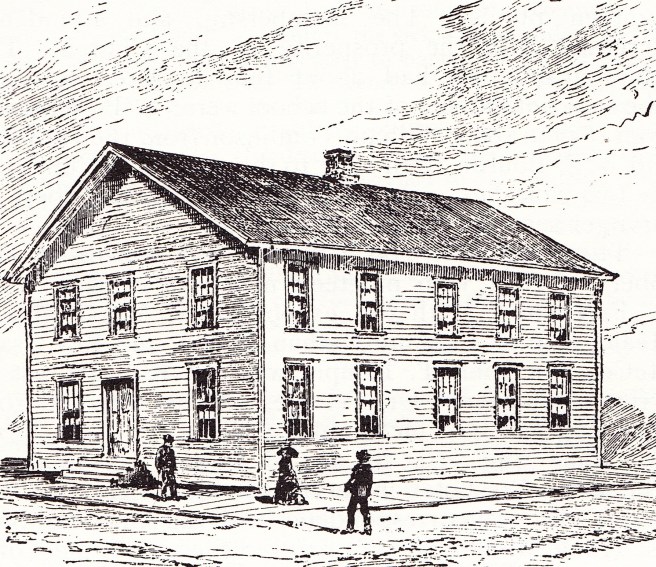
On July 4, 1833, Dr. John T. Temple, a Baptist, arrived in Chicago.  At first, he attended the Presbyterian services at the fort, but ideally he wanted to attend a Baptist service led by a Baptist minister in a Baptist building.  He, therefore, requested the American Baptist Home Missionary Society to send a minister, and in anticipation of his arrival started construction of a two-story frame building along the emerging S. Water Street corridor on the southeast corner of S. Water and Franklin Streets.  When Rev. Allen B. Freeman arrived in town on August 16, the Temple Building was ready for his use.  Temple had spent over $900 of his own money on Chicago’s first house of religion.  While the second floor was intended to provide space for a school, the ground floor was a hall for religious services.  In the spirit of the day, the Baptists graciously extended the use of the first floor hall to their Protestant cousins, while at the same time forthrightly denying any such use by the town’s Catholics.  

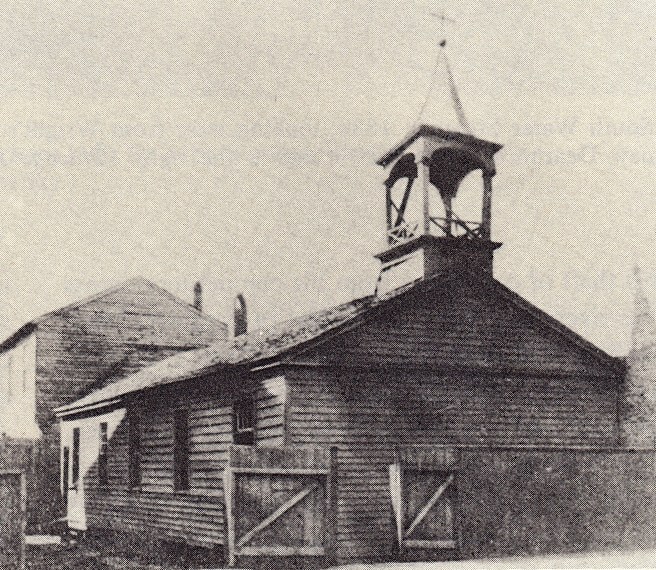
Augustine D. Taylor, St. Mary’s Catholic Church, southwest corner of Lake and State, 1833. The steeple was added at a later date. (Mayer and Wade, Chicago: Growth of a Metropolis)

Left out in the cold, the Catholics had no choice but to eventually respond with their own structure, if they did not want to lose the battle over Chicago’s many souls to those who had their own building for worship.  Therefore, the city’s Catholics had begun construction in August on Chicago’s first Roman Catholic church, St. Mary’s Church.  Located near the southwest corner of Lake and State Streets, one block removed from the bustling S. Water Street district, the plain, small (25′ by 35′) building was erected during August and September 1833 by carpenter Augustine D. Taylor, who had just arrived from Connecticut in June.  As the parish lacked the resources of Temple, and yet was in a hurry to complete the building in order to catch up with the Protestants, Taylor, therefore, employed Chicago’s new method of wood construction.  St. Mary’s was the most famous of the early balloon-framed structures because, until Sprague’s research, many historians believed it to have been the first balloon frame erected. By October the church was sufficiently completed to be dedicated, although the interior had not yet been plastered and the exterior still needed to be painted.  In fact, the building appeared quite stark (it cost only $400), for even the roof remained unbroken by a steeple or tower, which was not added until a later date.

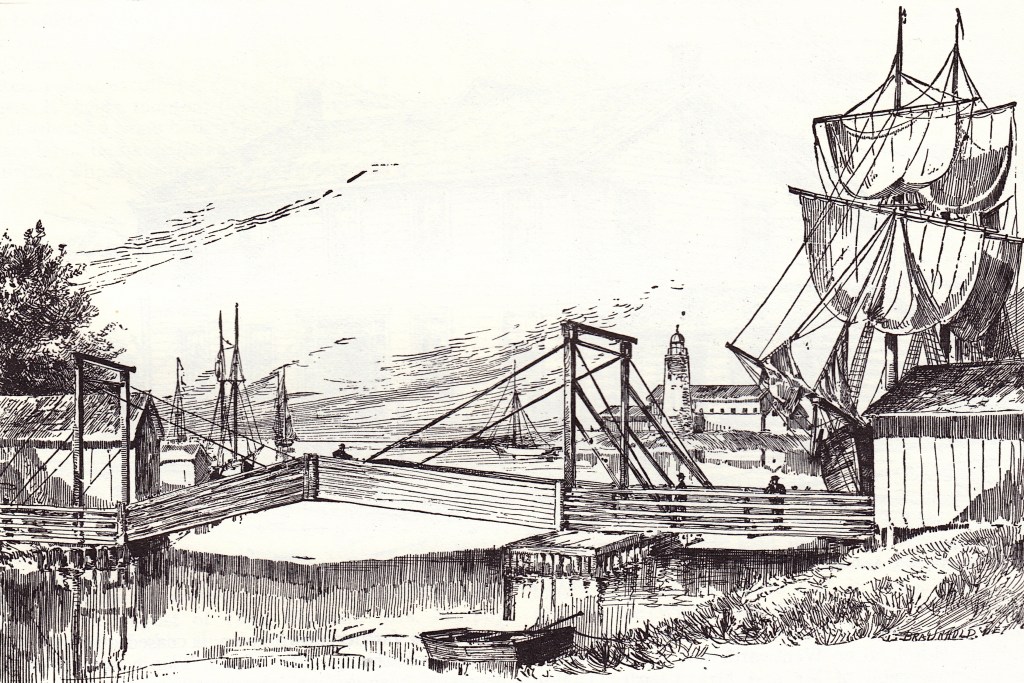
By this time the Presbyterians could afford to build a larger, more expensive building than the Temple Building.  Enjoying the hospitality of the Baptists, unlike the Catholics, they were not under any pressure to erect their building as fast as possible, so they were able to utilize the more traditional timber frame when they began work on the First Presbyterian Church on the southwest corner of Lake and Clark Streets.  The time involved with frame construction was evident in that the church wasn’t sufficiently completed by Joseph Meeker to be dedicated until January 4, 1834.  Somewhat surprisingly, Chicago’s first congregation, the Methodists, were the last to build a church, waiting until June 1834 to begin construction north of the river at the corner of N. Water and Clark Streets.  One of the first actions taken by the new town trustees had been the implementation of a free ferry in September 1833 across the Main Branch at Dearborn.  The Presbyterians’ decision to start construction may have been influenced by the start of work in March 1834, on the first bridge over the main branch of the river at Dearborn Street, only a block east of the lot owned by the Methodists.  Unlike the stationary Randolph Street bridge over the South Branch, the Dearborn bridge that opened in August 1834, was made a drawbridge with a sixty-foot opening, anticipating the river traffic soon to come.

Dearborn Street Drawbridge, 1834. (Andreas, History of Chicago-I)

FURTHER READING:

Andreas, Alfred T. History of Chicago, 3 vols. Chicago, 1884-1886. Reprint, New York: Arno Press, 1975.

Mayer, Harold  M., and Richard C. Wade. Chicago: Growth of a Metropolis. Chicago: University   of Chicago Press, 1969.

Pierce, Bessie Louis. A History of Chicago- I. New York: Knopf.  1940.

Tallmadge, Thomas Eddy. Architecture in Old Chicago. Chicago: University of Chicago Press, 1941.

(If you have any questions or suggestions, please feel free to eMail me at: thearchitectureprofessor@gmail.com)
3.6. THE BALLOON FRAME

South Water Street, ca.1832. This print was made in 1902, as a recreation of the area as it was in 1834. The area was much more built up in 1834 than pictured here, therefore, the scene is more accurate for a few years earlier. The Dearborn Street drawbridge at the far right should, therefore, not be included as it was not completed until August 1834. (Mayer and Wade, Chicago: Growth of a Metropolis)

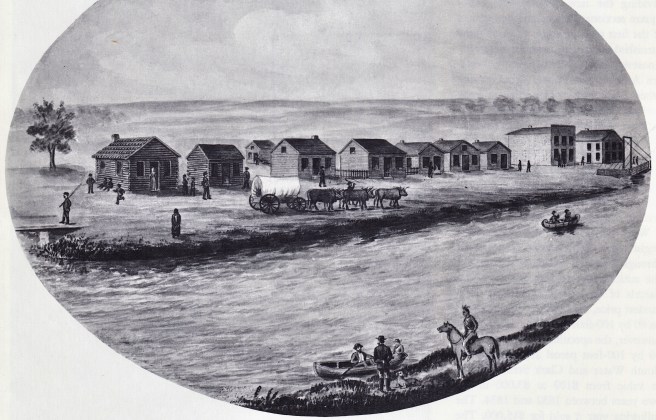
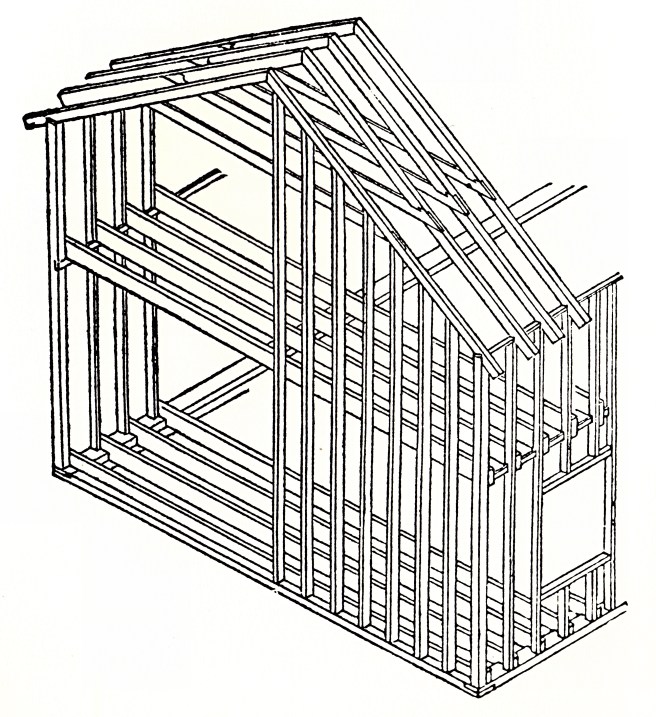
Prior to the land craze that had started in the fall of 1832, all buildings in Chicago, with a few notable exceptions, had been constructed employing log construction.  Chicago historian Alfred Andreas stated that the first timber-framed building (employing columns, beams, and diagonal bracing connected with mortise-and-tenon joints) in Chicago was erected in 1828 by the Federal government for the town’s favorite Pottawatomi chief, Sauganash (also known as Billy Caldwell), at the southeast corner of Chicago Avenue and North State Street.  It was not until 1831 that another framed building was erected: a two-story addition to the Eagle Inn operated by local raconteur Mark Beaubien, the younger brother of fur trapper Jean Baptiste Beaubien, that he had originally built on the southeast corner of Lake and Market, at the fork of the river’s two branches.  

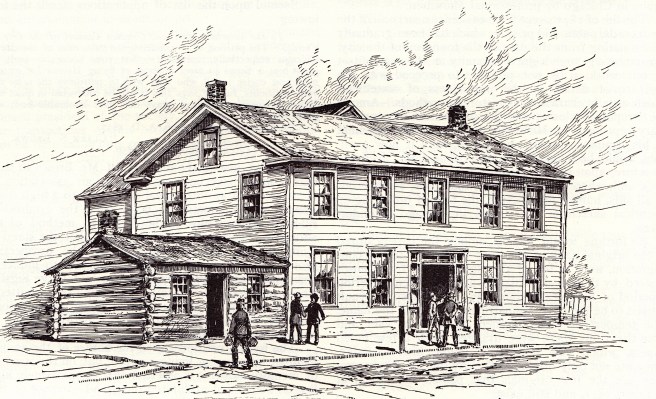
The Sauganash Hotel (formerly the Eagle Inn), southeast corner of Lake and Market. Named in honor of Chicago’s favorite Native American, also known as Billy Caldwell, the building consisted of a log house built in the 1820s by Mark Beaubien, with the two-story timber-framed addition being erected in 1831. (Andreas, History of Chicago-1)

With the completion of the addition, he changed its name to the Sauganash Inn in honor of the local Native chief.  Beaubien ran a ferry to transport folks across the South Branch to connect the town with the prairie to the west of the river, until the town’s first permanent bridge, a log bridge over the South Branch was erected by soldiers from Fort Dearborn under the direction of Anson Taylor, just north of Randolph.  This was wide enough for farmers from the west to drive their wagons over directly into the town’s business district.  There was also a footbridge across the north branch just above Wolf Point that was also constructed in 1832.

Chicago, 1830. Mark Beaubien’s original building at lake and Market. (Andreas, History of Chicago-1).

In 1832, Robert Kinzie had built his store on the West side incorporating a timber frame.  During the summer of 1832, George W. Dole built a framed building for business purposes located at the southeast corner of S. Water and Dearborn Streets, in the emerging business district paralleling the south bank of the Main Branch.  In the fall of 1832, Philip F.W. Peck, a recent arrival who hailed from Providence, RI, and had stopped in Chicago simply to sell the small inventory of goods he had originally planned to sell somewhere farther south, soon followed Dole’s lead and erected a framed building at the southeast corner of S.Water and La Salle into which he moved his growing business.  

As long as sufficient wood and time were available, the heavy timber frame had met Chicago’s needs more than adequately.  However, once settlers and, more importantly, land speculators began to descend upon Chicago in the latter half of 1832, the stunning growth in population in such a short time required a corresponding boom in the construction of suitable shelter for the newcomers, as well as appropriate commercial structures to service the increasing number of settlers moving through Chicago.  The situation was not unlike that of the preceding spring when makeshift shelters seemed to appear from nowhere due to the evacuation of the fort during the Black Hawk war in response Gen. Scott’s troops arrival with cholera.   The ensuing panic had sent the refugees once again desperately in search of shelter:

“The next morning in vain did we seek for a house.  A rail fence was, however, in sight.  Into one corner I moved.  A few boards made the floor.  Carpet kept off the wind from our heads and backs.  Other boards formed a far from water-proof roof.  Here we remained three days and nights, cooking on the ground… After three days Captain Johnson and my husband secured a lot of green lumber.  In sight of our fence stood the frame of a house.  To this the green boards were soon nailed and a temporary partition put in.  Here our two families moved.”

Reacting to a similar frantic need for temporary shelter in 1833, approximately 150 wooden buildings were erected in a manner best described by the recently arrived Charles Butler:

“But what was the condition of this objective point, this Chicago of which I was in pursuit, to which I had come?  A small settlement, a few hundred people all told, who had come together mostly within the last year or two.  The houses, with one or two exceptions, were of the cheapest and most primitive character for human habitation, suggestive of the haste with which they had been put up… Emigrants were coming in almost every day in wagons of various forms, and, in many instances, families were living in their covered wagons while arrangements were made for putting up shelter for them.  It was no uncommon thing for a house, such as would answer the purpose for the time being, to be put up in a few days… In the tavern at which we stayed, the partitions were chiefly upright studs, with sheets attached to them.”

Necessity, indeed, had been the mother of invention.  Butler had described, in essence, a technique not unlike that employed in the wigwam or teepee of the prairie Natives, who had been forced into a parallel nomadic existence by the recurrent waves of white settlement and displaced Natives.

Various buildings and people have been credited by historians as having been the first to utilize the new technique of balloon framing. Architect John Van Osdel recorded that George Snow was the inventor of the “balloon frame.”  Architectural historian Paul Sprague’s research uncovered that: 

“The first ‘balloon frame’ built in Chicago… was erected in the fall of 1832 by George W. Snow, and stood near the Lake Shore.  It was but a slight affair, yet served for the while, as his place of business and to protect his goods or freight received by vessel.”  

Snow had only just arrived in Chicago that fall, and the first recorded experiment with the balloon frame in his warehouse appropriately reflected the urgency of his business to hastily take advantage of the burgeoning influx of settlers at that moment.

Balloon Framing. This is different from contemporary “platform framing” in that the wall studs are continuous for two stories, not one, and the floor joists are nailed to the sides of the studs. (Sprague, JSAH, December 1981)

In essence, the balloon frame was a compromise between the solid bearing wall of logs used in a log cabin and the skeletal frame of widely spaced heavy timbers in a braced-frame building.  While the balloon frame’s smaller studs were still arranged in a frame-like construction, the spacing between the studs was relatively small, meaning that the wall, braced with its sheathing boards, structurally acted more like a bearing wall than a true skeletal frame.

I do not agree with the analogy drawn by many historians between Chicago’s development of the balloon frame and that of the iron skeleton frame.  The balloon frame moved away from the truly skeletal nature of the heavy timber frame to the more planar nature of the bearing wall, while the iron skeleton frame achieved a system of linear elements spaced far apart, similar to the heavy timber frame.  Although they both developed in Chicago, the structural concepts are not similar.

In addition to the speed of balloon framing, less skilled labor was needed to hammer its nailed connections than that needed to erect a braced frame that required a carpenter’s ability to craft a mortise-and-tenon joint.  Skilled carpenters during the initiation of the land boom must have been in great demand.  In even greater demand would have been timber, especially in the sizes needed for log or frame construction.  The smaller pieces used in balloon framing would have been easier to procure than mature timbers in the surrounding, lightly forested prairies. Unhindered by any legal building ordinances, the overwhelming success of the balloon frame would eventually allow Chicago one day to boast of being the largest wooden city in the world, while citizens of more substantially constructed cities would derisively refer to Chicago as the “Slab City.”

FURTHER READING:

Andreas, Alfred T. History of Chicago, 3 vols. Chicago, 1884-1886. Reprint, New York: Arno Press, 1975.

Dedmon, Emmett, Fabulous Chicago: A Great City’s History and People, McClelland and Stewart Ltd., Canada, 1981.

Industrial Chicago-vol. 1: The Building Interests. Chicago: Goodspeed, 1891.

Mayer, Harold  M., and Richard C. Wade. Chicago: Growth of a Metropolis. Chicago: University   of Chicago Press, 1969.

Sprague, Paul E., “The Origin of Balloon Framing,” JSAH, December 1981, p. 314.  

Wille, Lois. Forever Open, Clear, and Free; The Struggle For Chicago’s Lakefront. Chicago: Regnery, 1972.

(If you have any questions or suggestions, please feel free to eMail me at: thearchitectureprofessor@gmail.com)